Event Match Quality: Definition, Benchmarks & How to Improve It


Event Match Quality is one of the key metrics that determines how well Meta can match your website events to real users. If the signal is weak, your reporting, optimization, and ad performance all suffer, often without you realizing it.
| What you’ll learn in this article: ● What is Event Match Quality? ● How Event Match Quality Is Calculated ● What Is a Good Event Match Quality Benchmark? ● What Factors Affect Event Match Quality? ● How to Improve Event Match Quality |
What is Event Match Quality?
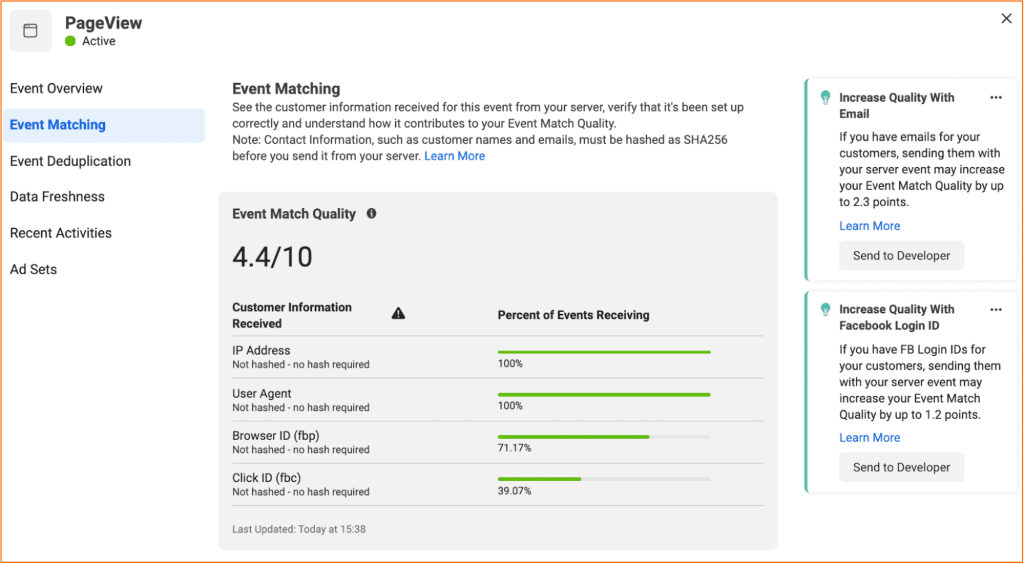
Event Match Quality (EMQ) is a Meta Ads metric that measures how accurately your website events, such as purchases, leads, add-to-cart, or page views, can be matched to real users on Facebook and Instagram. In simple terms, it shows how complete and reliable the customer data you send with each event is.
When someone performs an action on your site, Meta uses identifiers like email, phone number, name, IP address, browser data, and more to determine whether that action belongs to a known user. The stronger and more complete these identifiers are, the higher your Event Match Quality score becomes.
Meta grades this metric on a scale of Low, Medium, or High.
How is Event Match Quality Calculated?
Event Match Quality is calculated based on how many customer information parameters (CIPs) you send with each event, and how accurate those parameters are when Meta tries to match them to real users.
When an event fires (e.g., Purchase, Add to Cart, Lead), Meta looks at the customer data you send, such as:
- Phone number
- Name
- Zip code
- IP address
- Device ID
- Browser data (fbc, fbp)
- Payment info (hashed)
Meta then evaluates two things:
- Completeness – How many identifiers you included.
- Match accuracy – How many of those identifiers successfully matched a Meta user.
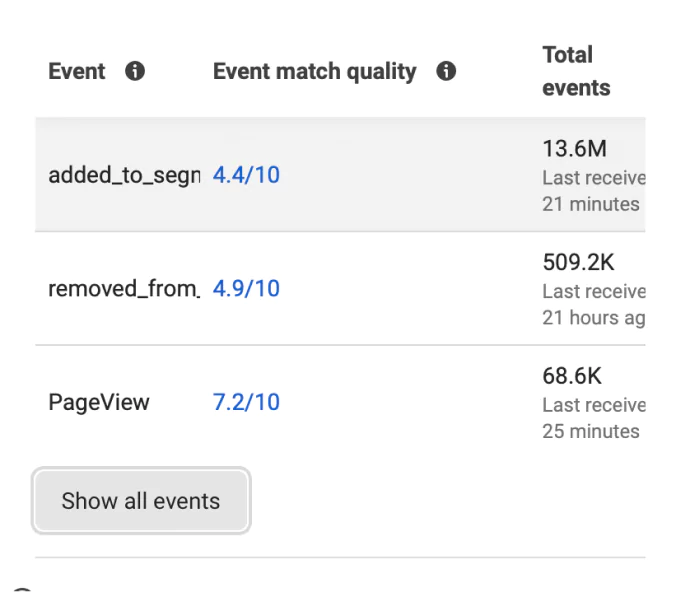
Using these two components, Meta generates a score for your event on a scale from 0 to 10, where:
- 8–10 = High
- 5–7 = Medium
- 0–4 = Low
A higher score means Meta has stronger confidence that the event belongs to a real, known user.
Example:
If your Purchase event sends:
- Email (✓)
- Phone number (✓)
- IP address (✓)
- Browser ID (✓)
- First name (✓)
- Last name (✓)
Meta can match the user easily: EMQ ~ 8–10 (High)
But if your Add to Cart event only sends:
- Browser ID
- IP address
Meta has fewer signals to work with: EMQ ~ 3–5 (Low–Medium)
What is a Good Event Match Quality Benchmark?
Because Meta (Facebook) calculates Event Match Quality (EMQ) on a 0–10 scale, advertisers commonly use these thresholds as benchmarks for evaluation:
- 8–10 (“High”): Excellent match quality, Meta can reliably link events to real user profiles.
- 5–7 (“Medium”): Acceptable, but there’s room for improvement, tracking and targeting may work, yet some conversions could be lost.
- 0–4 (“Low”): Weak match quality, many events may go unmatched or be attributed incorrectly, leading to inaccurate reporting and poor optimization.
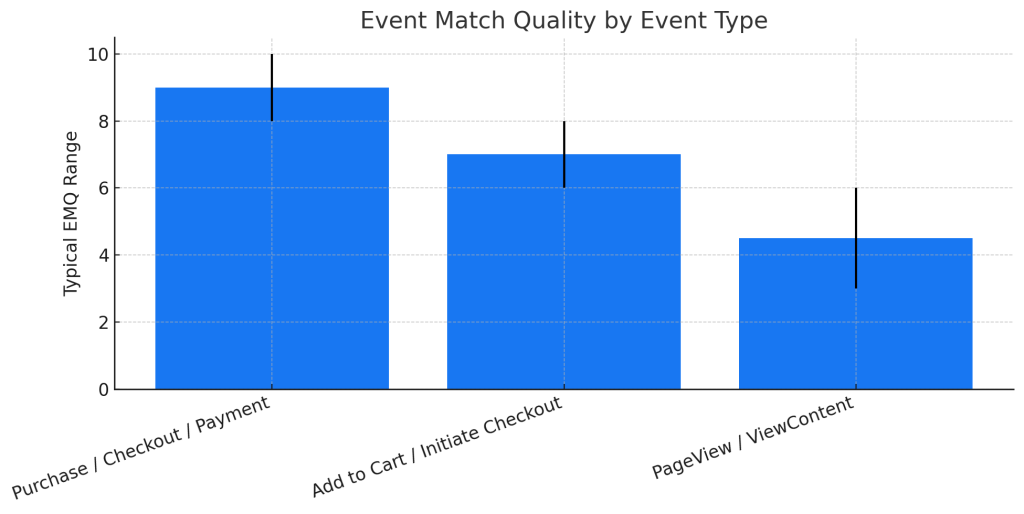
Typical Benchmarks by Event Type:
| Event Type | Typical EMQ Range | Notes |
|---|---|---|
| Purchase / Checkout / Payment | 8–10 | Highest quality since customers submit full personal data (email, phone, address) at purchase. |
| Add to Cart / Initiate Checkout | 6–8 | Good match if checkout forms capture contact info, otherwise may dip to Medium. |
| PageView / ViewContent / Browsing Events | 3–6 | Often only browser or device-level data, match quality tends to be lower. |
What Factors Affect Event Match Quality?
Several variables influence how accurately Meta can match your website events to real user profiles. Below are the core factors that shape your Event Match Quality score.
1. Completeness of Customer Information
The easier it is for Meta to match an event, the more identifiers you send, such as email, phone number, first name, last name, ZIP code, or IP. The absence of any data or partial data results in lower match accuracy and weakens the optimizing signals.
The EMQ can be significantly increased by just one more field, like the phone number added at checkout. High-intent events (Purchase, Lead) generally have better performance as they inherently gather richer customer data.
2. Data Formatting & Hashing Quality
The customer data needs to be normalized and hashed (SHA-256) by Meta in a very particular way. (SHA-256 is a cryptographic hashing algorithm that converts personal data into a long, irreversible string, ensuring the data is secure while still allowing Meta to match users accurately.) Errors like extra spaces, uppercase letters, or incorrect hashing lead to mismatches and lower your score.
Normalization done accurately ensures that all identifiers are processed without any issues, such as converting all inputs to lowercase, removing spaces, and standardizing country codes.
3. Event Setup & Pixel/Conversions API Integration
The events sent only through the pixel are heavily reliant on browser data which has been restricted since iOS 14. Utilizing both the Pixel and Conversions API boosts the reliability of events and strengthens the match signal.
The dual-channel setup also minimizes the data loss caused by ad blockers, connectivity issues, and tracking restrictions which collectively influence EMQ.
4. User Behavior & Touchpoint Type
Events associated with high-intent actions, such as checkout or form submissions, usually have high-quality matches because customers willingly provide personal information. Lower-intent events, like product views, have fewer identifiers.
This inherent difference means that browsing events could remain at Medium quality even if your setup is correct, simply because of limited customer data.
5. Data Privacy Settings & Platform Restrictions
Meta's access to identifiers is restricted by privacy settings, browser tracking limitations, and iOS opt-outs. Event matching becomes more challenging and EMQ drops when fewer signals come through.
Using Conversions API helps offset this loss, but full recovery isn’t always possible due to user-controlled privacy restrictions.

How to Improve Event Match Quality?
1. Send More Customer Identifiers
Meta’s matching engine performs best when it receives multiple identifiers per event, not just the basics. Email and phone are the strongest signals, but adding first name, last name, city, ZIP code, and country can dramatically improve match accuracy.
Many brands only send hashed email on Purchase events, which is fine, but insufficient. Meta’s documentation confirms that each additional identifier improves match confidence, especially when browser data is limited post-iOS14.
Example from real campaigns:
One merchant saw their Purchase EMQ jump from 6.2 > 8.7 simply by including:
- Phone number
- First name
- Last name
In addition to email. No other tracking changes needed. This is often the fastest win.
2. Fix Normalization & Hashing Errors
Most EMQ drops come from formatting mistakes before hashing. Meta requires normalized and SHA-256 hashed data, and even tiny deviations can break matching entirely.
Common mistakes:
- Leaving uppercase letters (e.g., “[email protected]”)
- Double spaces or trailing spaces
- Phone numbers without country codes
- Hashing raw text instead of normalized text
Why this matters:
If “John Smith” becomes “John Smith ” (two spaces) before hashing, the resulting hash doesn’t match Meta’s internal user hash, so the identifier becomes useless.
Quick cleanup checklist:
- Lowercase everything
- Trim all whitespace
- Normalize phone numbers > +84xxxxxxxxx
- Validate emails before hashing
- Hash using SHA-256
These fixes alone can recover 20–30% of your lost match potential.
3. Use Pixel + Conversions API Together
Running only on the Pixel is no longer enough.
Browser restrictions, cookie blocking, iOS opt-outs, and VPN usage mean pixel events fail or arrive incomplete.
Why dual setup matters:
- Pixel: sends browser-side signals (device, cookies, browser IDs)
- CAPI: sends server-side signals (email, phone, checkout data)
Together, they fill each other’s weaknesses. Meta specifically recommends this hybrid setup for high EMQ. This hybrid setup is the method Meta itself recommends for maintaining strong Event Match Quality after iOS 14.
If you want a simplified way to implement this on Shopify, tools like Omega Facebook Pixels automatically sync both Pixel and CAPI, normalize customer data, and recover events lost due to browser limitations.

Real performance example:
A clothing brand upgraded from Pixel-only to Pixel + CAPI and saw:
- Add to Cart EMQ: 4.0 > 7.5
- Initiate Checkout EMQ: 5.1 > 8.2
Within 48 hours, because server-side data fills the gaps left by browser blocking.
4. Strengthen Form Quality
Event Match Quality is only as good as the data users submit. Poorly designed checkout forms lead to bad data, typos, incomplete fields, invalid phone numbers, and Meta can’t match what it can’t read.
Enhancements that raise EMQ:
- Autofill enabled (reduces typos)
- Email & phone validation in real time
- Splitting first and last name fields
- Automatic formatting for phone numbers
- Making email “recommended” instead of fully “optional”
A more optimized form doesn’t just improve EMQ, it improves the conversion rate, too. Merchants often see fewer failed orders + stronger match data in the same week.
5. Reduce Event Noise
Some stores fire too many events or fire the same event multiple times (especially ViewContent, ATC, or custom events). This inflates event volume and makes user matching inconsistent.
Meta’s preference:
Fewer, cleaner, more accurate events.
Typical fixes:
- Fire each event only once per user action
- Remove duplicated ViewContent events on scroll
- Consolidate redundant custom events
- Ensure Purchase fires only after payment success
Clean event architecture makes it easier for Meta to match events consistently, and improves campaign optimization overall.

6. Avoid Fully Anonymous Checkouts
If users can check out without entering email, phone, or name, your EMQ will naturally be low, Meta simply doesn’t have enough identifiers to match.
You don’t need to force registration, but you can encourage light data capture with incentives.
High-performing approaches:
- “Get order updates via email or SMS”
- “Unlock free shipping when you add your phone number”
- Small entry discount: 5–10% off
- Autofill prompts during checkout
These additions are subtle, non-intrusive, and proven to increase the amount of matchable customer data.
7. Use Server-Side Tracking Platforms
Manually implementing CAPI is doable… but debugging it can be a nightmare.
Third-party server-side tools handle normalization, hashing, and event forwarding for you.
Reliable options include:
- Stape
- Elevar
- Littledata
- Tagfly
These platforms automatically clean your data, enhance event reliability, and often push EMQ up by several points within days.
Conclusion
Event Match Quality directly determines how well Meta can understand, match, and optimize your website events. When your data is complete, normalized, and supported by a Pixel + CAPI setup, Meta gains far stronger signals for attribution and delivery. Most stores see meaningful improvements simply by fixing identifiers, cleaning event architecture, and using tools that automate server-side tracking. A higher EMQ means clearer reporting, more efficient spend, and a system that actually learns from your real customers.

Shopify Conversion Tracking: A Complete Guide for Accurate Ad Data
Omega TikTok Pixel: New Conversion Analytics is here

Top TikTok Apps for Shopify Could Double Your Conversions
Deduplication in Facebook Pixel: How to Fix Duplicate Events and Track Data Correctly
Shopify Conversion Tracking: A Complete Guide for Accurate Ad Data
Top TikTok Apps for Shopify Could Double Your Conversions
Deduplication in Facebook Pixel: How to Fix Duplicate Events and Track Data Correctly
Omega TikTok Pixels Now Speaks Your Language: Introducing Multi-Language Support
Trakpilot New Feature: Export Your Conversion Events Data
Shopify Conversion Tracking: A Complete Guide for Accurate Ad Data
Top TikTok Apps for Shopify Could Double Your Conversions
Deduplication in Facebook Pixel: How to Fix Duplicate Events and Track Data Correctly
Omega TikTok Pixels Now Speaks Your Language: Introducing Multi-Language Support