ChatGPT ads pricing: CPC, CPM, and what budget you need


ChatGPT ads pricing works differently from a subscription or a fixed rate card. There is no monthly fee to advertise. Instead, you set a budget, choose whether to let the system bid automatically or give it a cost target, and pay for impressions or valid clicks won in an auction. That makes the most common question, how much do ChatGPT ads cost, harder to answer with a single number. OpenAI has suggested $3 to $5 as a starting bid for click campaigns, but it has not published average ad prices, so many figures quoted online are either starting bids, early pilot rates, or one advertiser’s results.
This guide explains how ChatGPT ads are billed, how bids and budgets work, what the minimum spend is, and how to plan a realistic monthly budget. It also covers how to tell whether the spend is worth it, because the price of a click matters less than what each click eventually costs you per sale.
How much do ChatGPT ads cost?
ChatGPT ads have no fixed price. You pay for the impressions or clicks your campaign wins in an auction, up to your budget and guided by any cost target you set. OpenAI publishes the rules and a few starting points, but not what advertisers typically pay:
| Cost element | What OpenAI says |
|---|---|
| Platform or subscription fee | No separate platform fee; you pay only for ad delivery |
| How you are billed | Per 1,000 impressions (CPM, or cost per mille) or per valid click (CPC), depending on the campaign objective |
| Recommended CPC bid | $3 to $5 suggested as a starting bid for click campaigns; it is a starting point, not an average price |
| Minimum daily budget | $25 per campaign in the US, with the minimum varying by the billing currency of your ad account |
| Average CPC or CPM | Not published |
In practice, that means the smallest possible test in the US costs about $750 for a month. What you pay per click or per thousand impressions depends on competition, your bid strategy, and how relevant your ads are to the conversations they appear next to.
One point causes confusion in many guides. The price of ChatGPT Plus or other paid plans has nothing to do with advertising costs. Those are subscriptions for users, and ads are shown to users on the Free and Go plans, not to Plus, Pro, Business, Enterprise, or Edu accounts.
For the full rules on minimum spend, see OpenAI’s campaign setup guide.
How has ChatGPT ads pricing changed in 2026?
If you search for ChatGPT ads costs, you will find figures that range from a $25 daily budget to six-figure commitments. Most of that gap comes from timing. Pricing changed several times this year as OpenAI moved from a small managed pilot to self-serve buying:
| Period | How ChatGPT ads were sold |
|---|---|
| Early 2026 pilot | Managed deals with selected advertisers, at a reported $60 CPM and large minimum commitments |
| April 2026 | Digiday reported that CPMs had fallen from around $60 and that minimum commitments had dropped to about $50,000, still under the managed pilot |
| May 2026 | OpenAI begins rolling out the self-serve Ads Manager in beta, with CPC bidding running in parallel with CPM buying |
| Mid-2026 onward | A $25 minimum daily budget per campaign in the US, and daily budgets treated as the average amount you want to spend per day over a seven-day period |
| November 2026 | Target CPC and Target CPA replace Max CPC and Max Bid for new campaigns; the old controls retire on January 1, 2027 |
The $60 CPM and the large minimums still appear in many articles, but they described the pilot, not what a business pays when it signs up today. Treat any figure without a date with caution, and check OpenAI’s own documentation before building a budget around it.
How does ChatGPT ads pricing work?
Your actual cost comes from four things working together: the objective you choose, the bid strategy you choose, the budget that paces delivery, and how relevant your ads are to the conversations they appear next to. The sections below cover each one.
1. Billing models: views, clicks, and conversions
The campaign objective decides what you pay for. ChatGPT ads are sold in a relevance-weighted, second-price auction, with CPM, CPC, or conversion-optimized bidding. OpenAI’s advertiser guide groups these into three objectives:
| Objective | What you pay for | Best suited to |
|---|---|---|
| Views | Each 1,000 impressions, up to your maximum CPM | Launches and awareness, where reach matters more than clicks |
| Clicks | Each valid click, with the system working toward your target CPC if you set one | Traffic tests, since cost per click is easy to compare with other channels |
| Conversions | Each valid click (oCPC) or each 1,000 impressions (oCPM), depending on the billing option you choose | Campaigns with reliable conversion tracking already in place |
The Conversions objective is easy to misunderstand. OpenAI’s conversion-optimized campaign guidance states that delivery is optimized toward your selected conversion event, but billing follows the option you choose, valid clicks or impressions, not conversions. You can also set a Target CPA, the average cost per conversion you want the system to work toward. It is a goal, not a guaranteed price, and billing still follows clicks or impressions. A conversion campaign that drives few sales still costs money, so it only pays off when the system has accurate conversion data to learn from.
Not every visit counts as a billable click, either. Ad-review crawlers may load your landing page with tracking parameters attached, and some analytics tools record those visits as paid traffic, but they are not billable clicks. A lower CPM does not automatically mean better value. Compare it with click-through rate and the sales that follow, not impressions alone.
2. Bids and the auction
Since August 2026, OpenAI’s Maximize results strategy has been the default for eligible new ad groups in Ads Manager. It sets and adjusts bids automatically to get as many clicks or conversions as possible from your budget, without promising a specific cost per result.
If you want more control over cost, you can add a cost target. From November 9, 2026, Target CPC replaced Max CPC for new click campaigns, and Target CPA replaced Max Bid for new conversion campaigns. Existing campaigns keep their old bid settings until January 1, 2027, when they move to the new targets automatically. Views campaigns still use a maximum CPM.
A target works differently from the old maximum bid. Max CPC capped every bid. With Target CPC, the system can bid above or below your target in each auction to win as many clicks as possible at your desired average. Because the auction is second-price and weighted by relevance, a well-matched ad can still win for less than a less relevant one.
Two numbers are often quoted as prices but are really starting points:
- $3 to $5 per click: OpenAI’s suggested starting bid for click campaigns. It was introduced as a maximum bid, and OpenAI has not yet said whether the same range applies to Target CPC. Either way, it is not an average cost.
- $60 per thousand impressions: Some advertisers have reported that Ads Manager pre-fills a $60 maximum CPM bid on Views campaigns. If so, that is a ceiling rather than a price.
Ads Manager may also show bid-strength guidance, which indicates whether a bid is likely to be competitive or may limit delivery. If delivery is low, raising the bid is one option, but sharper context hints or a better-matched landing page can lift relevance without increasing what you pay per click.
3. Budgets, pacing, and daily minimums
Each campaign uses one of two budget types: a total budget for the whole campaign, or a daily budget. Choose carefully, because if you change a campaign budget to a daily budget, you can’t change that campaign back to a campaign-total budget.
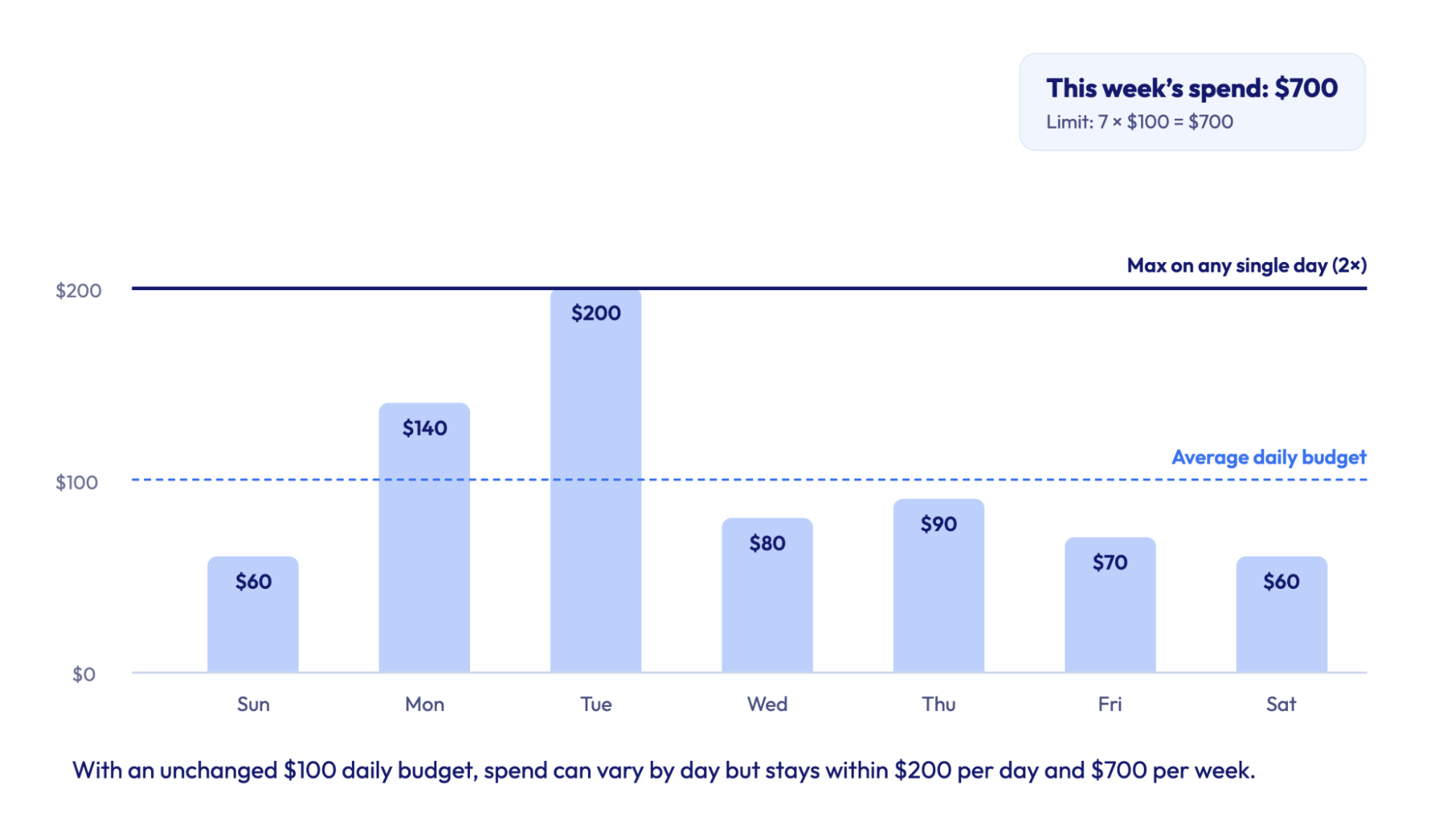
A daily budget works as an average, not a hard limit. According to OpenAI’s daily budget guidance, a daily budget is the average amount you want your campaign to spend per day over a seven-day period, and if delivery is below your daily budget on some days, unused amounts may be used later in the same seven-day period. You may be billed up to twice your selected daily budget on an individual day, but your campaign will not spend more than seven times your daily budget over the applicable seven-day period.
With an unchanged $100 daily budget, a campaign can spend up to $200 on a busy day and no more than $700 across the seven-day period, which runs from Sunday to Saturday in your ad account’s time zone.
Minimum daily budgets depend on your billing currency:
| Currency | Minimum daily budget |
|---|---|
| USD, CAD, AUD | 25 |
| EUR, GBP | 15 |
| INR | 725 |
| JPY | 2,500 |
For campaigns that use a daily budget and a maximum bid (Views campaigns, or campaigns still on Max CPC or Max Bid), the daily budget also has to be at least as high as the highest effective bid in the campaign’s ad groups, including audience bid adjustments. A large bid paired with a small daily budget will block the change until one of them is lowered.
4. What drives your actual cost
Two advertisers with the same bid and budget can end up paying very different amounts per click. The main factors are:
- Competition for the same conversations: categories where many businesses want to appear, such as software, travel, or finance, tend to push prices up.
- Relevance: because the auction weighs relevance as well as bids, ads with clear copy, well-matched context hints, and a landing page that answers the question tend to win more often at a lower price.
- Market: costs vary by country and currency, and markets where ChatGPT ads launched more recently may have fewer advertisers competing.
- Timing: busy shopping periods usually bring more competition for the same impressions.
- Objective and bid strategy: with Maximize results, the system sets bids toward your goal within your budget. With a Target CPC or Target CPA, a realistic target lets the system compete for more auctions, while a target set too low may limit delivery.
There is also no reliable market average to compare against yet. OpenAI has not published average CPM, CPC, click-through rate (CTR), or conversion rate figures, and says it has no benchmarks yet. Figures shared online usually come from a small number of advertisers in specific categories. Until wider data exists, the most useful benchmark is the cost per click and cost per sale from your own first campaigns.
How much should you budget for ChatGPT ads per month?
There is no standard monthly cost for ChatGPT ads, because you set the budget yourself. The more useful question is how much you need to spend to learn something you can act on.
As of October 2026, ChatGPT ads are available in 89 countries, and minimum budgets vary by billing currency. The floor is low. At the minimum daily budget, one US campaign running for a month costs about $750. That is enough to get ads running, but often not enough to tell whether they work, especially if your product needs many clicks for each sale.
Two formulas turn a budget into expected volume:
| Estimate | Formula |
|---|---|
| Clicks | Monthly budget ÷ expected CPC |
| Impressions | Monthly budget ÷ expected CPM × 1,000 |
With $5,000 a month and an expected CPC of $5, you can plan for roughly 1,000 clicks, or about 500 clicks if the CPC is closer to $10. At an expected CPM of $40, the same budget buys about 125,000 impressions. Actual results will vary with the auction.
For the expected CPC, don’t plan around OpenAI’s $3 to $5 figure. It is a suggested opening bid for manual campaigns, not an average price. Early reported figures are higher, from about $4.41 for one ecommerce advertiser to $10.62 for the US in Synter’s test. A planning range of about $5 to $10 may therefore be more realistic for US campaigns, and you can replace it with your own data as soon as you have it. Reported figures vary widely.
According to Search Engine Journal’s roundup, Common Thread Collective reported an average CPC of $4.41 across about $9,620 of spend for a high-order-value ecommerce advertiser. Synter reported an average of $9.89 across about $4,429 of spend, with market averages ranging from $5.10 in the UK and $10.62 in the US to $17.59 in Australia and $22.89 in New Zealand. These are early observations from limited test spend, not OpenAI benchmarks.
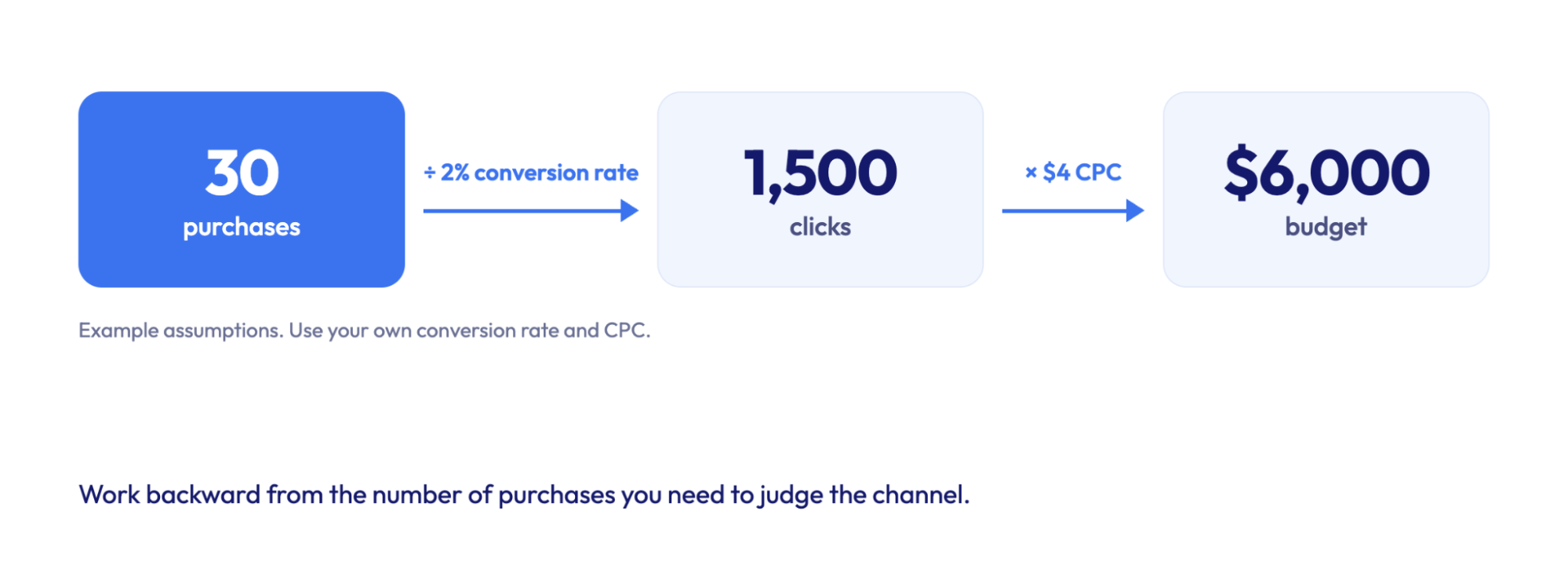
A more reliable approach is to work backward from the decision you need to make. Suppose you want 30 purchases before judging the channel, and your site converts about 2% of visitors. You would need around 1,500 clicks, or about $7,500 at a $5 CPC and up to $15,000 at a $10 CPC.
The table below shows how budgets typically scale. The ranges are planning assumptions, not OpenAI guidance:
| Budget level | Monthly spend | What it can tell you |
|---|---|---|
| Minimum test | $750 to $2,500 | Whether ads deliver, plus early CTR and CPC for one offer |
| Practical pilot | $5,000 to $10,000 | Directional results for one or two campaigns, including early cost per purchase |
| Growth pilot | $15,000 to $30,000 | Comparisons across products, markets, or creative, with more reliable conversion data |
A focused campaign with enough budget usually learns faster than several thinly funded ones, as long as its offer and context hints are not too broad. Run the test for at least a few full seven-day pacing periods, so delayed purchases have time to appear.
Media spend is also only part of the cost. Creative, landing page work, and any agency or tool fees belong in the same calculation.
Your expected CPC or CPM tells you how much traffic a budget can buy. Conversion tracking tells you whether that traffic is worth buying.
How do you know if ChatGPT ads are worth the cost?
A low price per click does not make ChatGPT ads cheap, and a high one does not make them expensive. A $4 click is costly if it rarely leads to a sale. A $10 click can be worthwhile if it regularly brings in high-value orders. The number that settles the question is your cost per purchase:
Cost per purchase = ad spend ÷ purchases attributed to the campaign |
Compare that figure with the most you can afford to pay for one order. That limit comes from your margins, the same idea as break-even ROAS (return on ad spend) in Google Ads. If your cost per purchase sits below it, the channel is earning its place, even when its CPC is higher than search.
None of this works without conversion tracking. Ads Manager only reports purchases if your store sends them through OpenAI’s Measurement Pixel, its Conversions API, or both. Using both gives the most complete picture, as long as both send the same event ID for each purchase so it is counted once. Without that data, you are left judging the channel by clicks alone.
For Shopify stores, Omega ChatGPT OpenAI Ads Pixel connects purchase data to ChatGPT Ads without changes to your theme. It installs the OpenAI pixel through Shopify’s official web pixel, adds the server-side Conversions API, and matches browser and server events automatically so each order is counted once. Key shopping events, from product views to purchases, reach Ads Manager, where you can compare campaigns and ad groups by cost per purchase instead of clicks. The app is free to use.
It is also worth checking results against your own records. Tag ChatGPT ads traffic with UTM parameters, compare attributed purchases with orders in your store, and watch whether other channels report fewer sales during the test. A shopper who sees a ChatGPT ad and later searches your brand on Google may be counted by both platforms, so total revenue is the final check.
Before you decide whether ChatGPT ads are expensive, make sure you can see what each click turns into.
How can you lower your ChatGPT ads cost?
The goal is a lower cost per purchase, not just a cheaper click. A lower CPC only helps if the clicks you still win are likely to buy. These changes tend to make the biggest difference:
- Tighten your context hints: focus each ad group on one product or customer need, and describe who it suits and when it is useful. More relevant matches can win auctions at a lower price.
- Give the system more creative to work with: OpenAI advises building for coverage with many distinct titles and descriptions per offer. Several variations let Ads Manager find the versions that earn more clicks for the same spend.
- Match the landing page to the ad: OpenAI uses the landing page as a relevance signal, and a page that answers the shopper’s question also converts more of the traffic you pay for.
- Set realistic cost targets: if you add a Target CPC, start from OpenAI’s suggested $3 to $5 range or your own data, then adjust in small steps based on delivery and cost per purchase, rather than raising the target to force volume.
- Choose the objective that fits your stage: Start with Clicks while you confirm purchases are tracked, then create a new Conversions campaign, since existing CPC or CPM campaigns cannot be switched over. If available, choose impression billing (oCPM): OpenAI says it can drive more conversions than click billing because it also counts conversions after an ad view, and recommends pairing it with Maximize results.
- Concentrate your budget: fund a few focused campaigns properly instead of spreading the minimum across many.
- Cut what does not convert: once you have enough data, pause ad groups, or rewrite their context hints, when cost per purchase stays above your limit, and move that budget to the ones that perform.
Most of these changes require no additional media spend. They work because the auction rewards relevance, so a better-matched ad can cost less and convert more at the same time.
Final thoughts
ChatGPT ads pricing is simpler than the range of numbers online suggests. You set a budget, let the system bid or give it a cost target, pay for impressions or valid clicks, and can start from $25 a day per campaign in the US. The $3 to $5 figure is where OpenAI suggests starting click bids, and your own results will show what you actually pay.
Plan your first month around the decision you need to make. Estimate how many clicks it takes to reach a meaningful number of purchases, give the test a few full weeks, and judge it by cost per purchase rather than CPC.
If you sell on Shopify, set up purchase tracking before the first dollar is spent. Omega ChatGPT OpenAI Ads Pixel is free to install and sends purchase events to Ads Manager from both the browser and the server, so your test is judged on sales, not clicks alone.
How Long Should You Wait Before Judging a Google Ads Campaign?
Where Google Click IDs Get Lost Between the Ad and Checkout
Enhanced Conversions in Google Ads: Turned On Isn’t the Same as Working
Google Ads Shopify Orders: How Many Are Tracked?
Shopify Direct Traffic Isn't Always Direct
How Long Should You Wait Before Judging a Google Ads Campaign?
Where Google Click IDs Get Lost Between the Ad and Checkout
Enhanced Conversions in Google Ads: Turned On Isn’t the Same as Working
Google Ads Shopify Orders: How Many Are Tracked?