ChatGPT ads: What they are, how they work, and what advertisers need to know in 2026


ChatGPT ads are sponsored placements that appear below ChatGPT’s answers. In 2026, they moved from a small test to a self-serve channel open to businesses in a growing list of countries. For advertisers, the appeal is timing. People use ChatGPT to describe a problem, compare options, and narrow down a choice, so an ad can reach them while that decision is still taking shape. The trade-off is control. ChatGPT ads do not offer the keyword targeting or query-level reporting advertisers are used to in Search, which makes a careful testing and measurement setup important from day one.
This guide explains what ChatGPT ads are, who can run them, and how OpenAI selects and prices them. It also compares them with Google Ads and walks through how to set up and measure a first test. Along the way, it separates what Ads Manager reports from the sales your store can actually confirm.
What are ChatGPT ads?
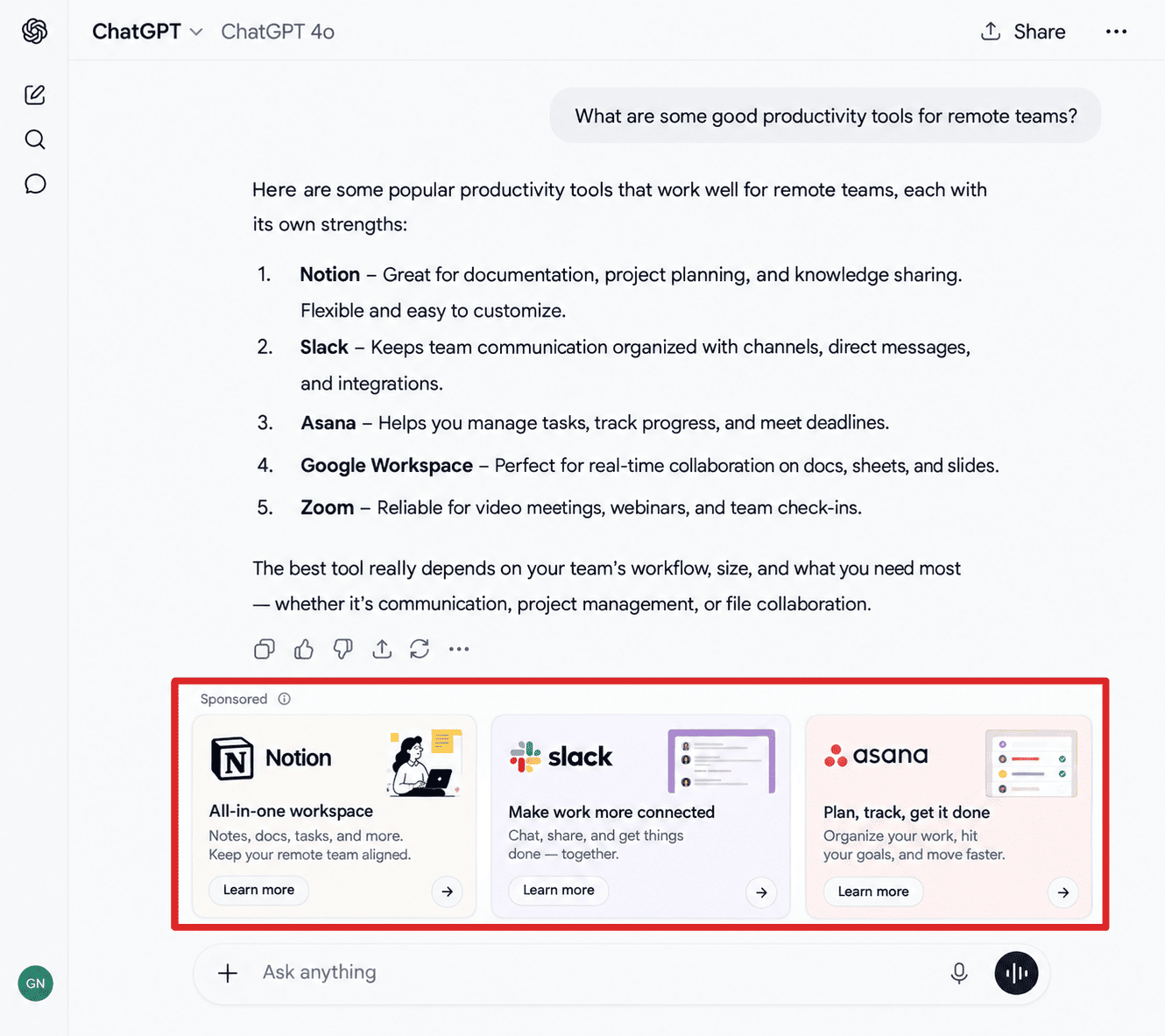
ChatGPT ads are paid placements that businesses buy through OpenAI's advertising platform, often called OpenAI Ads. When a conversation is relevant to what an advertiser offers, a labeled sponsored unit can appear below ChatGPT's answer, with the advertiser's name, a headline, a short description, an image, and a link to a landing page. Advertisers create and manage these ChatGPT advertisements in Ads Manager.
The ad sits outside the answer itself. OpenAI's ad principles state that ads do not influence the answers ChatGPT gives, and that conversations stay private from advertisers. That separation shapes what marketers can buy. You can pay to appear next to a relevant answer, but you cannot pay to be mentioned in it. Being recommended inside ChatGPT's responses is an organic visibility question, separate from advertising.
Not every ChatGPT user sees ads:
- Shown to: users on the Free and Go plans.
- Not shown to: Plus, Pro, Business, Enterprise, or Edu accounts, or accounts identified as belonging to someone under 18.
- Ad-free option: OpenAI says it will always offer a way to avoid ads, including an ad-free paid tier.
For advertisers, that means your potential audience is people on eligible plans who are asking about something related to what you sell, in the markets where ads are live. Those markets have expanded quickly through 2026.
Does ChatGPT have ads now?
Yes, ChatGPT has ads now. They have appeared since early 2026, and businesses can buy them directly instead of going through an invitation-only pilot. Here is how access has expanded:
| Date | Key milestones |
|---|---|
| January 2026 | OpenAI announces plans to test ads at the bottom of ChatGPT answers and publishes its ad principles |
| February 2026 | Ad testing begins with a pilot in the United States |
| May 5, 2026 | OpenAI begins rolling out a beta self-serve Ads Manager, where businesses can register, set budgets and bids, upload ads, and view performance |
| August 2026 | ChatGPT Ads expands to 31 European markets, with self-serve access through Ads Manager available from August 31 |
| September 16, 2026 | OpenAI begins testing Sponsored Agents with select US advertisers and launches its first integrations with HubSpot and Shopify |
| October 21, 2026 | ChatGPT Ads expands to 26 more countries, bringing availability to 89 countries worldwide |
If you are planning a ChatGPT ads test in 2026, keep in mind that Ads Manager is still labeled as a beta, so formats, bidding options, and reporting keep changing. Access also depends on where your business is based and where you want to advertise. Check OpenAI’s supported countries list before you commit budget or creative, since it has grown several times this year.
How do ChatGPT ads work?
Every ChatGPT ad follows the same basic path. A user asks a question, OpenAI’s ads system checks which eligible ads are relevant to that conversation, an auction picks one, and the ad appears below the answer. What happens after the click depends on your landing page and your tracking. The six parts below follow that path.
1. Where ads appear and what they look like
OpenAI’s advertiser guide confirms that ads appear below ChatGPT responses, not inside them. The unit is compact, so it competes with the answer above it for attention. A clear image and a headline that makes sense at a glance matter more here than long copy, because most users read the answer first and decide in a second whether the ad is worth a click.
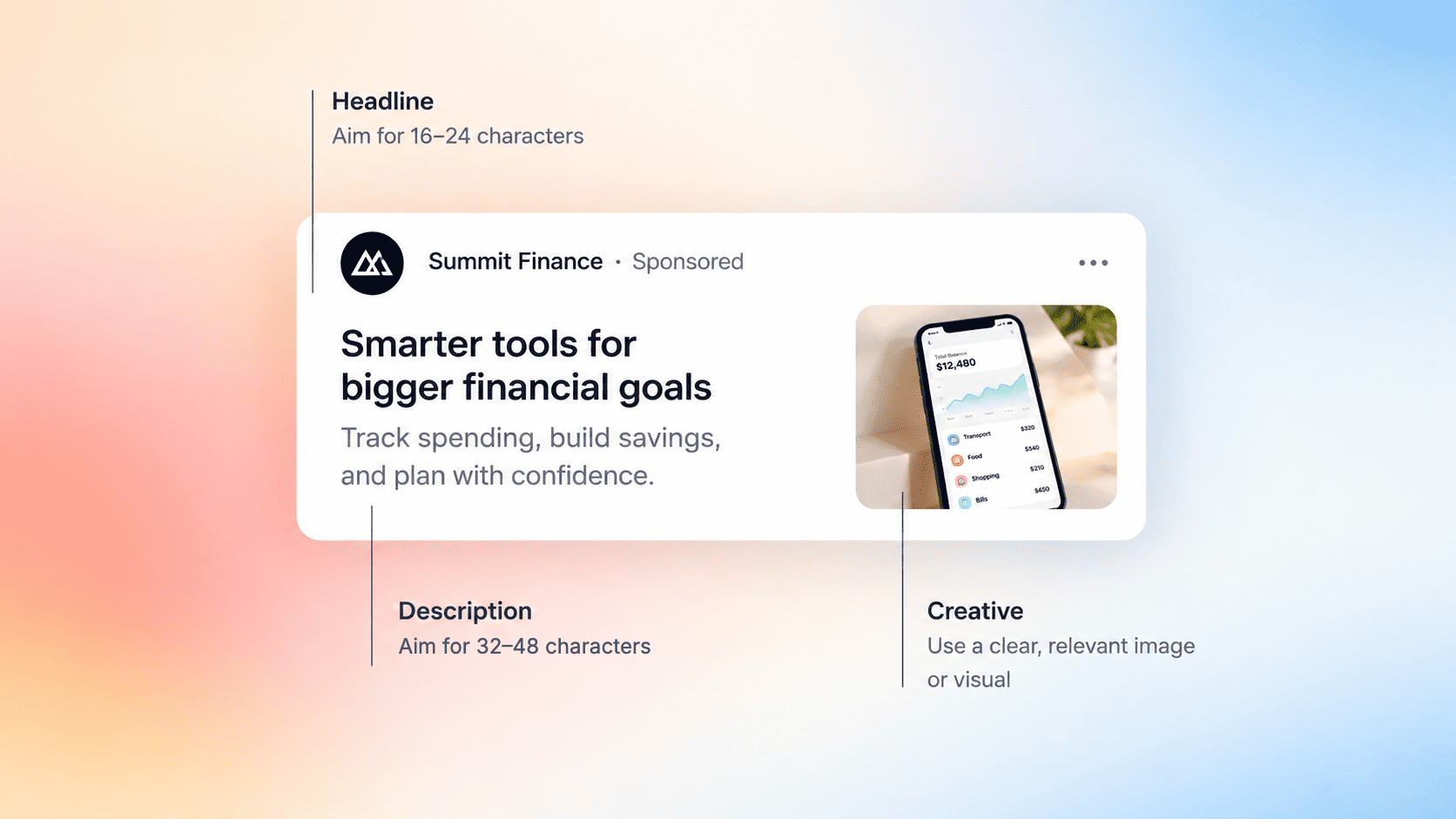
The landing page is part of the ad, too. OpenAI uses it as a relevance signal, and ad-review crawlers may visit it before an ad goes live. A page that matches the ad helps both the review and the user who clicks.
For ecommerce, ads can also draw on a product feed. OpenAI’s Shopify integration, for example, syncs a store’s catalog into a ChatGPT Ads product feed, which helps keep product information current.
Formats are still developing. OpenAI has said it will add more formats, objectives, and buying models over time, and one new format is already in testing.
Sponsored Agents. Sponsored Agents let people chat with an AI representative of a business in ChatGPT, opening a conversation from an ad to ask questions about the business’s products or services. The conversation is clearly labeled, distinct from ChatGPT’s independent answers, and separate from the original conversation the user started. OpenAI’s example is a shopper considering a dining table who wants to ask about dimensions, seating capacity, or how to care for the finish before visiting the business’s website.
For now, OpenAI’s Sponsored Agents FAQ says the format is available only to selected advertisers in a limited alpha test, and OpenAI is not accepting early access requests. You may see Sponsored Agents in ChatGPT even if the format isn’t available for your campaigns.
2. How ads are selected
OpenAI’s ads system chooses which ad to show based on expected relevance and outcomes. It weighs several signals at once:
- The context and intent of the current conversation
- Your landing page, headline, and ad copy
- The context hints you add to each ad group
- When a user has ads personalization turned on, select signals from their wider ChatGPT use
When several ads are eligible, a relevance-weighted, second-price auction decides which one appears. This changes how you compete. A higher bid does not guarantee the placement, because a more relevant ad can beat it. And in a second-price auction, the winner generally pays based on what it takes to beat the next competitor, not its full maximum bid.
OpenAI says the system aims to maximize value for both advertisers and users. In practice, the parts you control, such as your copy, landing page, and context hints, matter as much to winning the auction as your bid does. That is why context hints deserve a closer look.
3. Context hints vs keywords
Context hints are the closest thing ChatGPT ads have to keywords, but they work differently. You add them at the ad group level to describe the conversations, topics, or keywords where your product may be relevant. They help guide matching, but they are not exact-match keywords and do not guarantee delivery in any specific conversation. In OpenAI’s context hint guidance, hints inform relevance; they are not targeting rules or delivery instructions.
The biggest shift is in how you write them. OpenAI suggests a clear, natural phrase focused on one idea, rather than a list of disconnected keywords. The difference looks like this:
| Keyword-style list | Context hint |
|---|---|
| running shoes, trail shoes, waterproof shoes | Waterproof trail running shoes for runners who train through wet winters |
| leather gifts, anniversary gifts | Personalized leather gifts that ship in two days, for last-minute anniversary presents |
A useful way to draft them is to answer three questions from OpenAI’s framework: what your product offers (features, pricing, availability), who it suits, and when it is useful. Each hint should add something your ad and landing page do not already make clear.
To keep hints effective:
- Keep each ad group focused: group hints around one shared product, theme, or customer need.
- Update them when the offer changes: new pricing, promotions, availability, or service areas should be reflected in your hints.
4. Campaign structure, objectives, and bidding
ChatGPT ads use a familiar three-level structure:
| Level | What you set there |
|---|---|
| Campaign | The objective and campaign-wide settings |
| Ad group | Bids, context hints, and, for retailers, the product set |
| Ad | Headline, copy, image, and landing page |
The objective decides what you pay for and what the system optimizes toward. OpenAI currently offers three:
- Views: impression-based buying, with a maximum CPM bid set at the ad group level.
- Clicks: optimizes for traffic, with a maximum CPC bid. OpenAI recommends starting at $3 to $5 per click.
- Conversions: optimizes toward a supported standard conversion event. With click billing, you still pay for valid clicks, not for conversions.
Ads Manager may also show bid-strength guidance, which signals whether a bid is likely to be competitive or may limit delivery. Because the auction weighs relevance as well as price, raising the bid is not the only fix when delivery is low. Sharper context hints or a better-matched landing page can help just as much.
For a first test, Clicks is usually the simplest starting point. The Conversions objective becomes more useful once your tracking reliably reports purchases, since the system can only optimize toward the events it receives.
5. Privacy and brand safety
ChatGPT ads are built with tighter limits on data than most ad platforms. Inside ChatGPT, advertisers receive aggregated performance data, never personal details or conversations. OpenAI also says it uses guardrails to prevent narrow ads targeting. Ads personalization, which draws on a user’s wider ChatGPT activity, only applies when the user has it enabled.
For advertisers, this has a practical effect. You cannot see which conversation led to a click, and you cannot build audiences from what people asked. Anything you learn about buyers has to come from your own site, through your landing page, analytics, and conversion tracking.
On brand safety, OpenAI’s safeguards are designed to keep ads away from sensitive user contexts and brand-unsafe environments, including those listed in OpenAI’s Ads Policies. The same policies restrict which products and categories can be advertised, so check them before building a campaign. Qualifying advertisers can also use Negative Phrases for narrower placement requirements based on their own brand policies, though this option is not available to every advertiser.
6. Reporting and measurement in Ads Manager
Ads Manager reports the core delivery metrics: impressions, clicks, spend, CTR, average CPC, average CPM, and conversions. Impressions, clicks, and CTR refresh about every 15 minutes, while spend can lag by 7 to 8 hours, so a spend figure of zero early in the day does not mean nothing has been charged.
Conversions only appear once you set up measurement. OpenAI’s measurement documentation covers two main methods:
- Measurement Pixel: a JavaScript pixel on your site that sends standard or custom conversion events from the browser.
- Conversions API: sends conversion events server-to-server, so it does not depend on the visitor’s browser to report what happened.
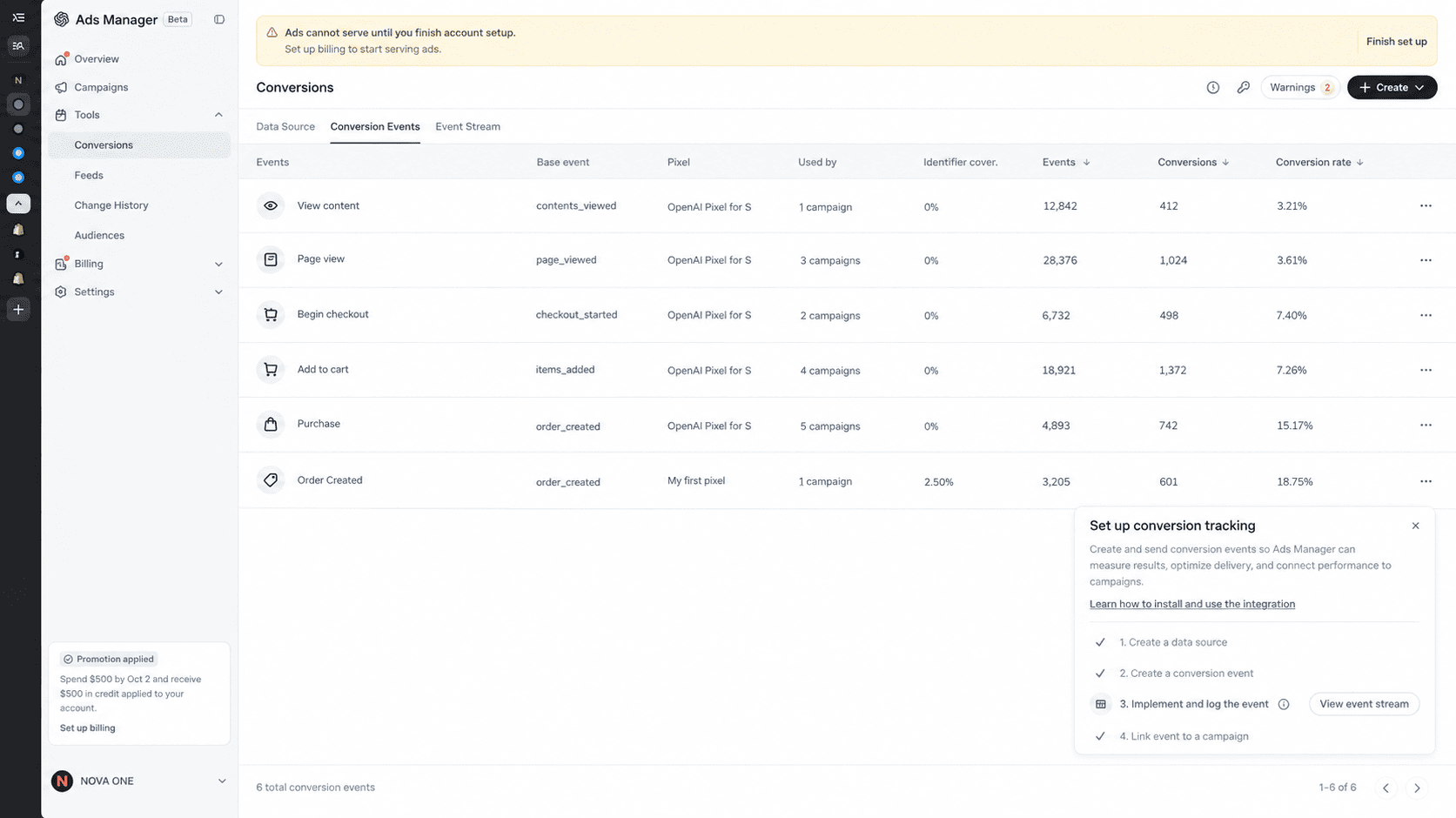
You can also add static UTM parameters to landing page URLs. They persist on ad clicks, so ChatGPT traffic shows up in the analytics tools you already use. One quirk to know: ad-review crawlers may visit landing pages with those parameters, and some analytics tools classify these as paid visits, even though they are not billable clicks.
Ads Manager shows what happened inside ChatGPT. Whether those clicks turned into sales is a separate question, and it is the part that decides whether the test was worth it. The setup and measurement section below covers it in more detail.
Put together, ChatGPT ads reward relevance as much as budget. The conversation, your context hints, and your landing page decide when an ad appears, and your tracking decides whether you can prove it worked. That is why the platform behaves differently from Google Ads, even where the setup looks familiar.
ChatGPT ads vs Google Ads: What’s different?
If you already run Google Ads, much of the ChatGPT Ads setup will feel familiar: campaigns, ad groups, bids, and conversion tracking. The differences lie in how ads are triggered and how much you can see.
The last row matters most. Someone who searches “waterproof trail running shoes size 10” on Google is close to buying. Someone who asks ChatGPT how to stay dry on winter trail runs may still be working out what they need. ChatGPT ads can reach that person earlier, but an earlier click often takes longer to turn into a purchase.
For most stores, ChatGPT ads work best as an addition to Search, not a replacement. Keep your Search and Performance Max campaigns running as your baseline, give ChatGPT ads a separate test budget, and judge them by what they add to total sales, not by whether their CTR or CPC beats your search campaigns.
When are ChatGPT ads worth testing?
ChatGPT ads are still a young channel, so the more useful question is whether your store is ready to learn from a test.
| Test now if | Wait if |
|---|---|
| Shoppers research or compare before buying your products | Your products sell mainly on impulse or by brand name |
| Your landing pages explain the product clearly on their own | Key pages are thin, slow, or out of date |
| Purchases are tracked reliably from browser and server | Conversion tracking is incomplete or untested |
| You can set aside a test budget you are prepared to learn from | Every dollar must return a profit from the first week |
| Your products fall within OpenAI’s allowed ad categories | Your category is restricted under the Ads Policies |
| You are comfortable without query-level reporting | You rely on keyword-level control to manage spend |
Most stores will not tick every box, and that is fine. If the left column mostly fits, a small, well-tracked test will tell you more than most benchmarks. If the right column mostly fits, fixing those gaps first can also help the channels you already run.
If you decide to test, the next section covers how to set it up.
How should you set up and measure a ChatGPT ads test?
A ChatGPT ads test is only useful if you can trust what it tells you. Most of that depends on a campaign narrow enough to learn from and tracking that is in place before the first click.
Set up the campaign
In Ads Manager, businesses register, add payment information, set budgets, bids, and pacing, upload ads, and launch and manage campaigns in one place. For a first test, keep the setup simple:
- Objective: Clicks for a first test, as covered above.
- Budget: use a separate test budget so ChatGPT spend does not compete with your proven channels.
- Ad groups: build one ad group per product line or customer need, not one for the whole store.
- Context hints: write a few focused hints for each ad group, using the what, who, and when approach above.
- Creative and landing page: match the headline and image to the page the click lands on.
- UTMs and policies: add UTM parameters to every landing page URL, and check the Ads Policies before launch.
Set up conversion tracking before launch
Without conversion tracking, Ads Manager can only report clicks, and the Conversions objective has nothing to optimize toward. The most complete setup uses both the Measurement Pixel and the Conversions API, so purchases can still reach Ads Manager when a browser blocks the pixel. When both send the same event, they need a shared reference so it is counted once, not twice.
Shopify stores can set this up through an app. OpenAI's own Shopify app connects your catalog and commerce events to Ads Manager. It launched for US merchants in September 2026 and has since expanded to most markets where ChatGPT ads run.
Alternatively, Omega OpenAI ChatGPT Ads Pixel installs the OpenAI Ads pixel, adds the server-side Conversions API, and matches pixel and server events automatically to prevent double counting. It tracks key shopping events from product views to purchases, lets you create campaigns inside the app, and is free. Plus, attribution and reporting still happen in Ads Manager.
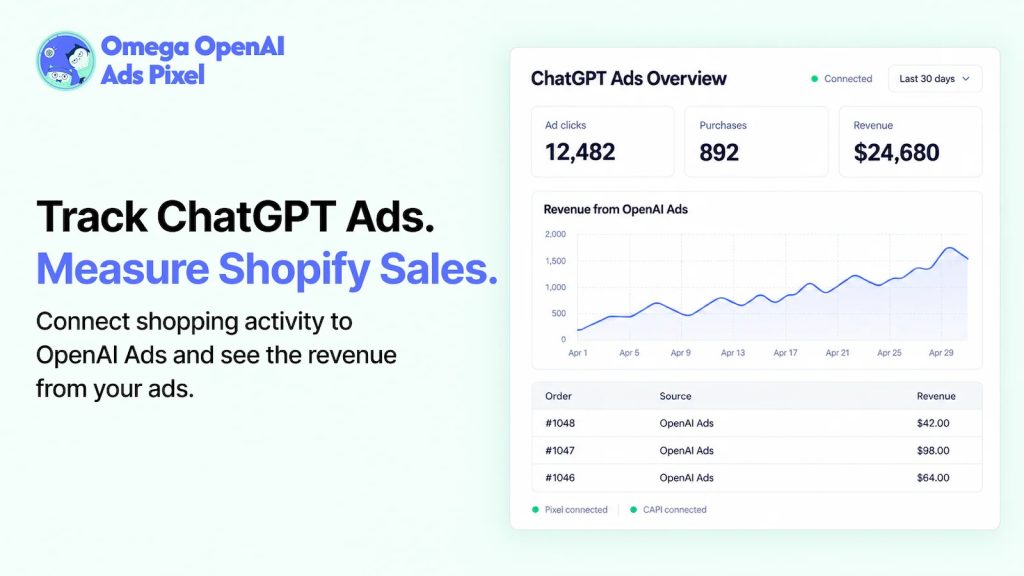
*Note: Before launch, place a test order and confirm the purchase appears in Ads Manager. Make sure purchases reach Ads Manager from both the browser and the server before you spend on clicks.
Judge the test against your own data
Decide what success means before launch. Set a target cost per purchase or ROAS based on your margins, and agree on how long the test will run. Because ChatGPT users often click while they are still comparing options, give the test enough time for delayed purchases to come in.
Then compare three views of the same period:
- Ads Manager: clicks, conversions, and spend reported by OpenAI.
- Your store: orders from sessions tagged with your ChatGPT UTMs.
- Your other channels: whether Google Ads or other campaigns report more or fewer sales than usual.
The third check matters because channels overlap. A shopper might see a ChatGPT ad, search your brand on Google a day later, and buy. Both platforms may then claim the sale. Looking at total store revenue alongside each platform's report shows whether ChatGPT ads added new sales or mainly shared credit for sales you would have made anyway.
Final thoughts
ChatGPT ads give stores a way to reach shoppers while they are still working out what to buy, a moment that search ads often reach later. The platform has moved quickly from pilot to self-serve in 2026, but it still offers less control and less visibility than the channels most advertisers know.
That makes preparation the most important part of a first test. Focused ad groups, clear context hints, and landing pages that answer the shopper’s question give the system something relevant to work with. Reliable tracking, checked against your own store data, tells you whether the test actually worked.
If you sell on Shopify, set up browser and server tracking before your first campaign goes live. Omega OpenAI ChatGPT Ads Pixel is free to install and helps purchase events reach Ads Manager from both sources, so your test starts with data you can trust.
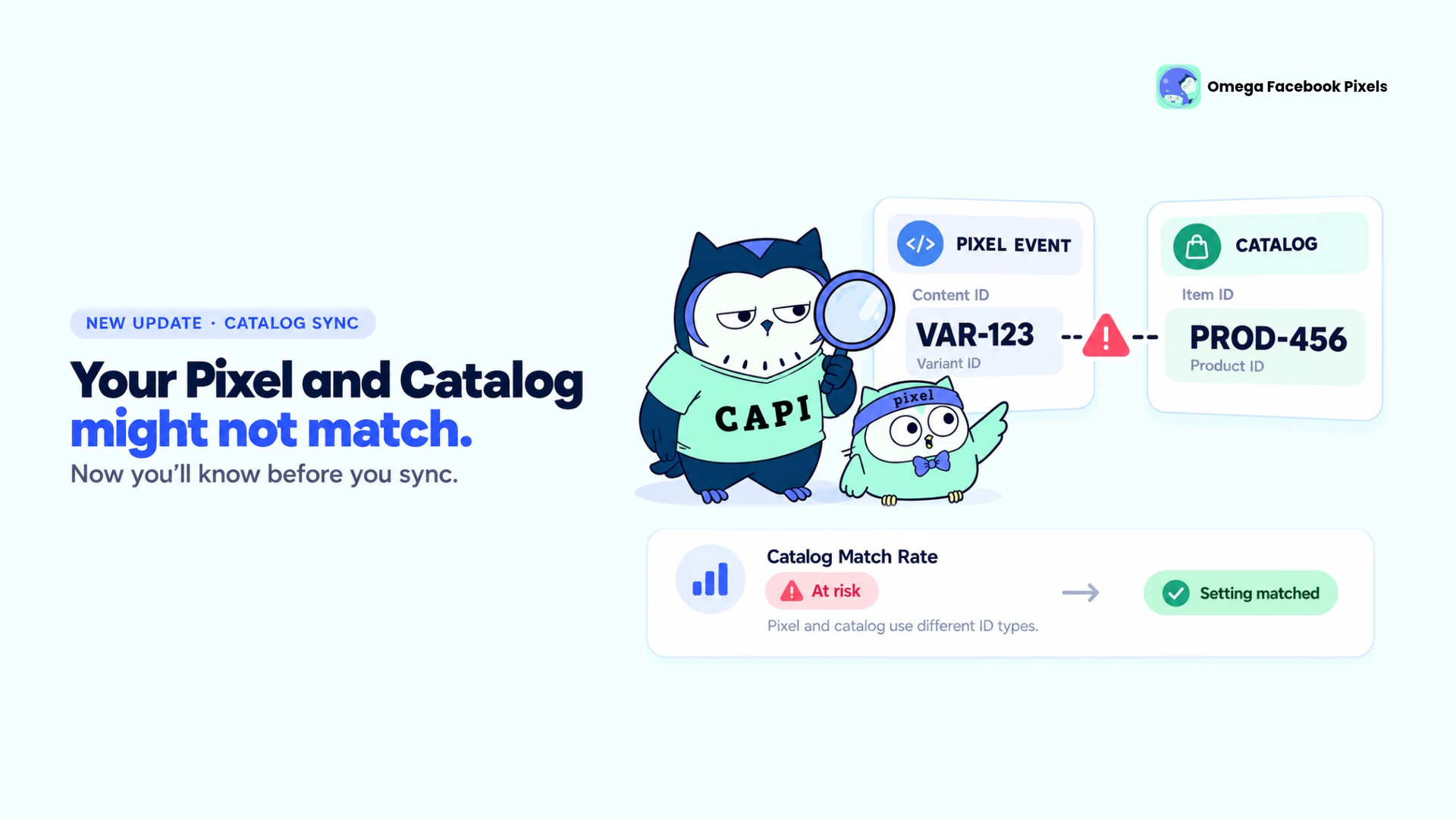
Omega Facebook Pixels Catches Catalog and Pixel Mismatches Before Your Match Rate Drops
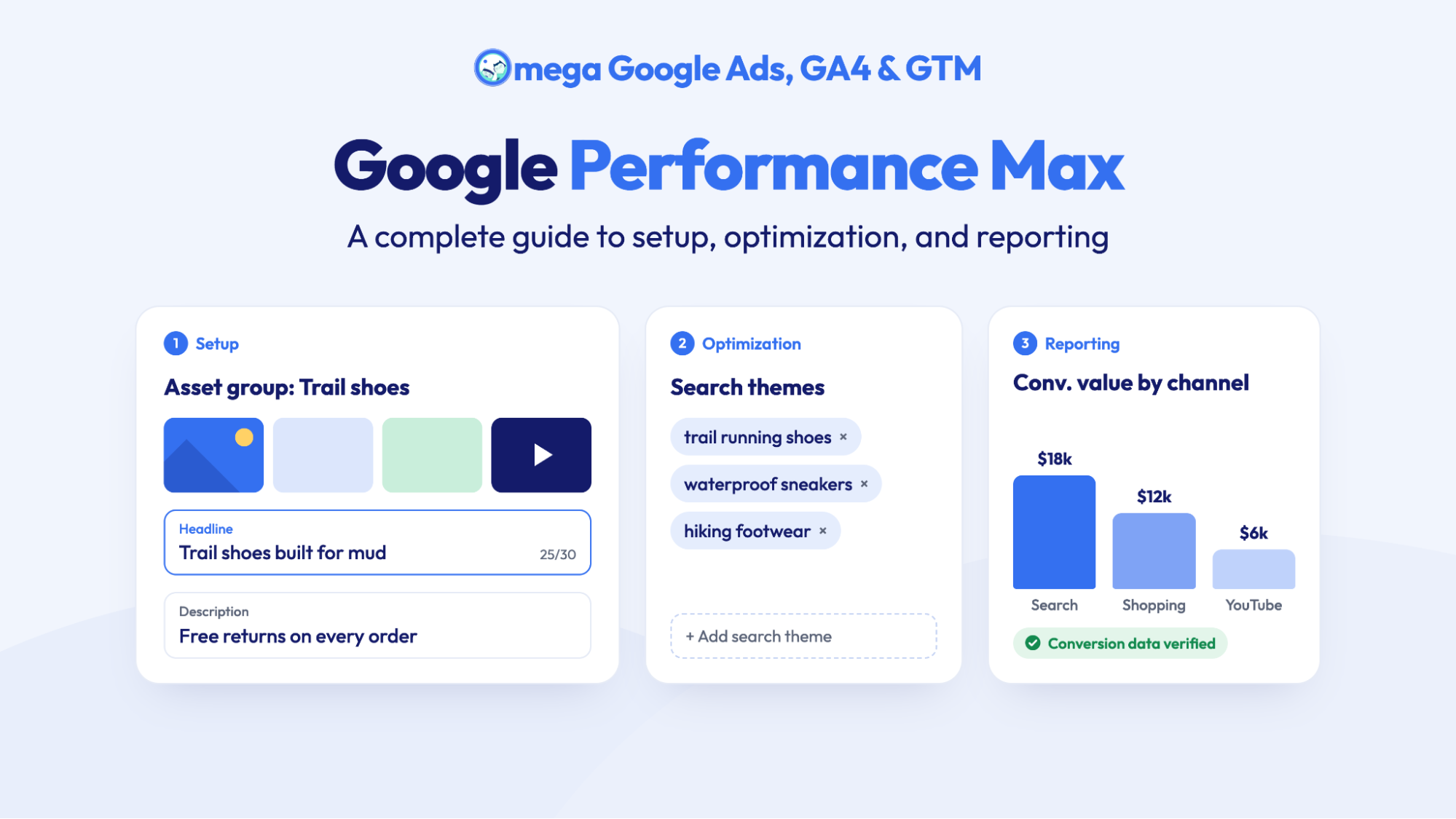
Google Performance Max: A complete guide to setup, optimization, and reporting
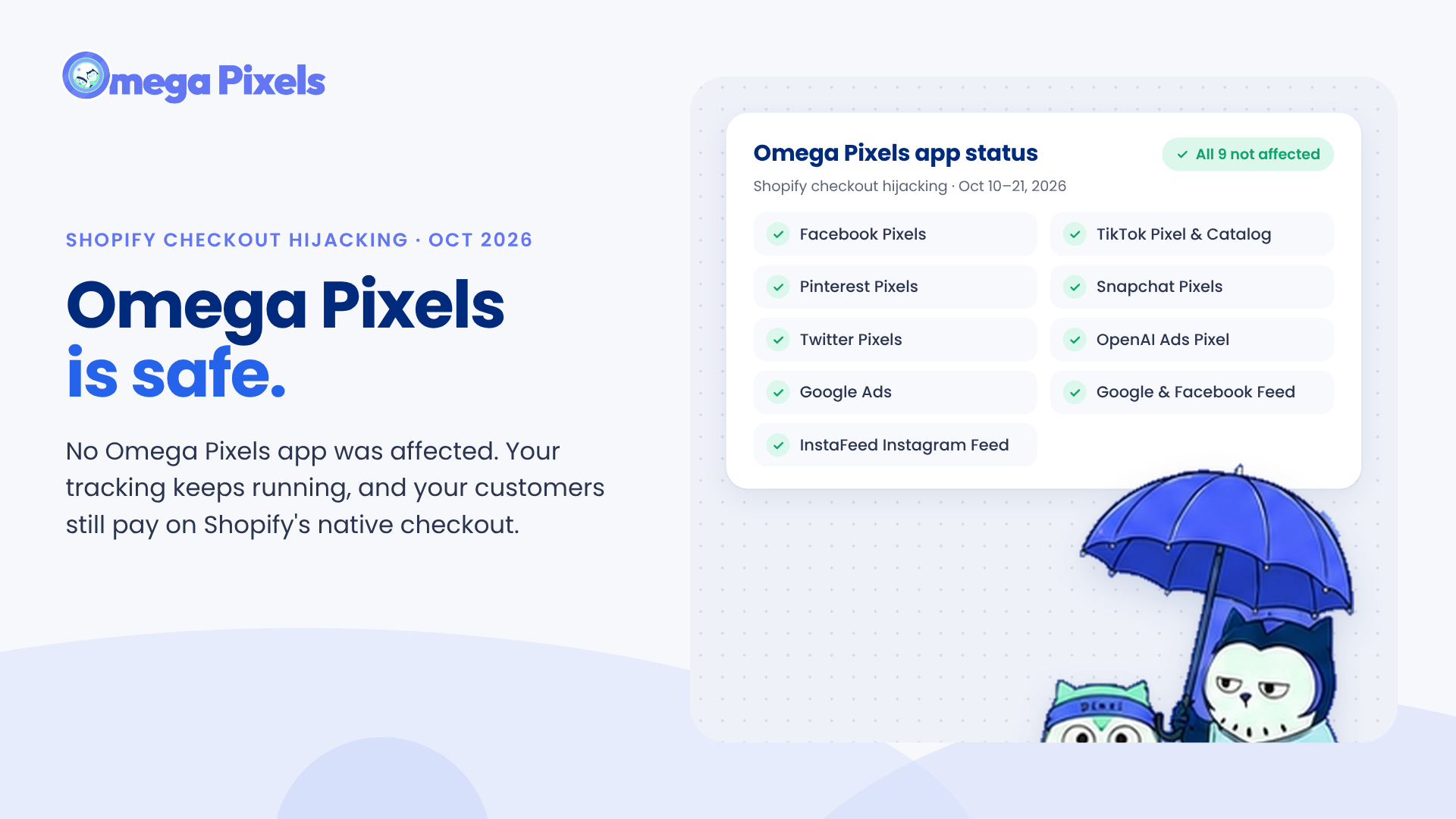
Are Omega Pixels Safe After the Shopify Checkout Hijacking? Yes, Here's Why
Google Performance Max: A complete guide to setup, optimization, and reporting
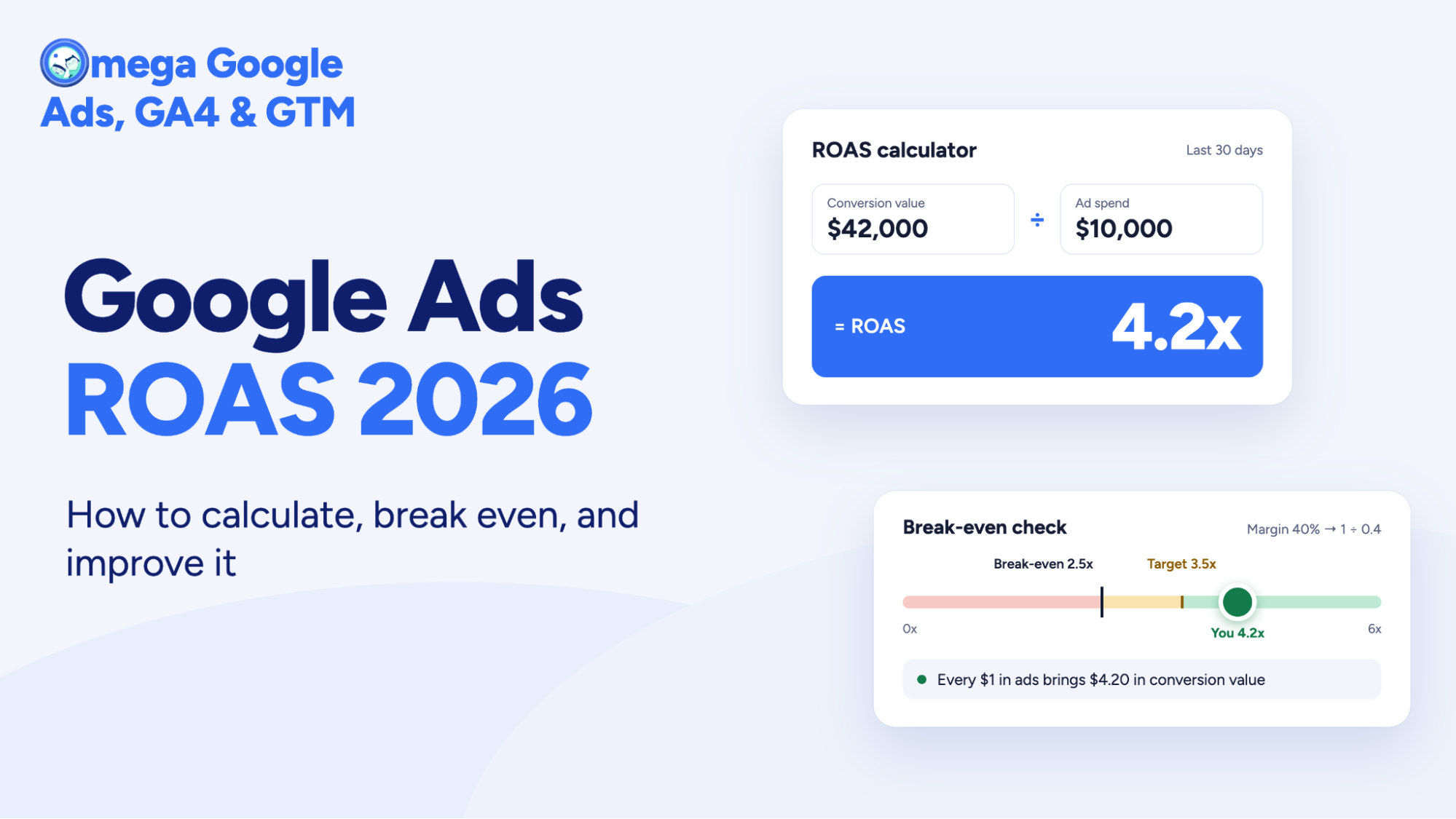
Google Ads ROAS 2026: How to calculate, break even, and improve it
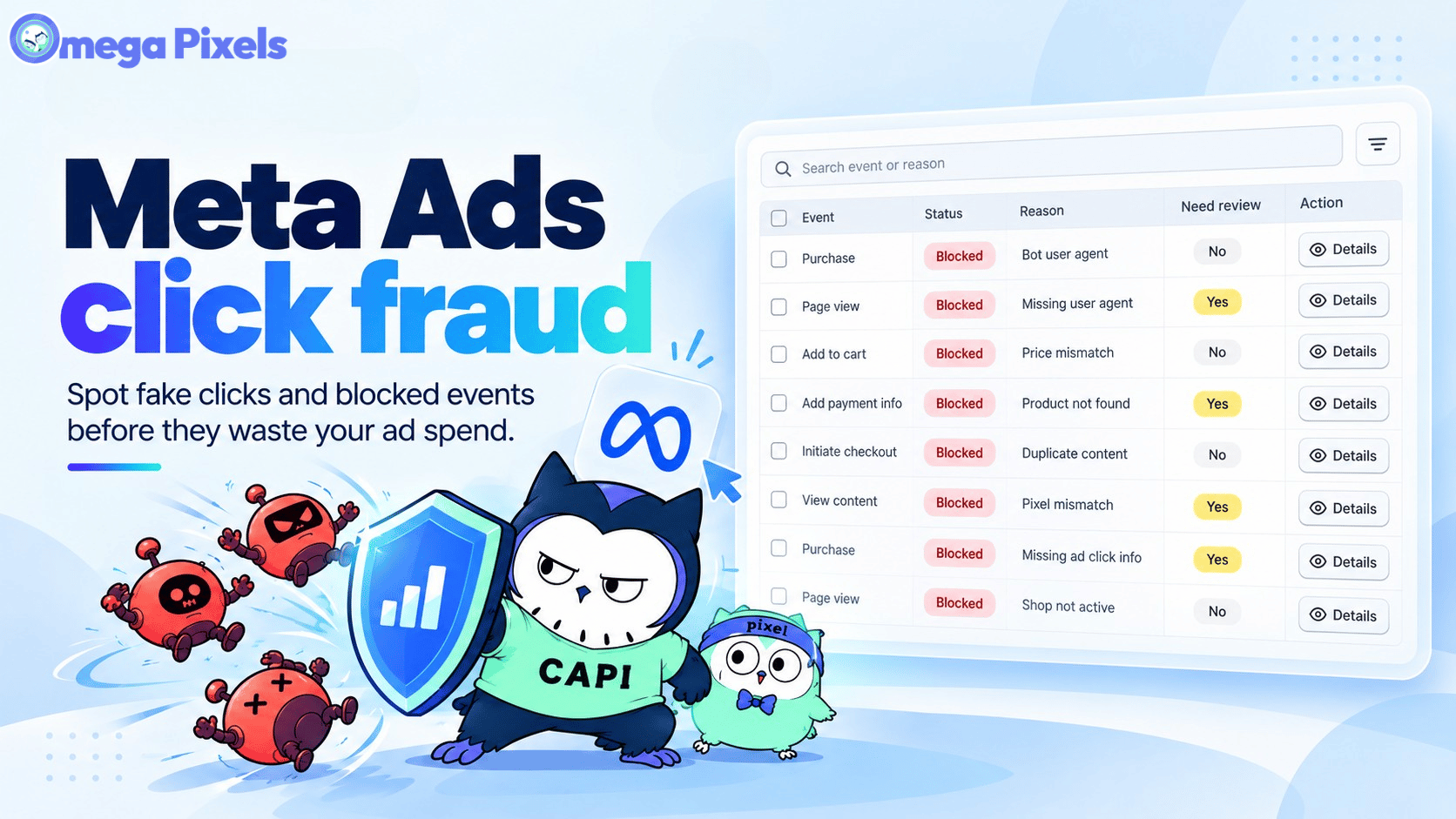
Meta Ads Click Fraud: How Bots Drain Your Budget and Poison Your Pixel (2026 Guide)
Google Ads ROI: 7 Ways to Get More Value From Every Ad Dollar
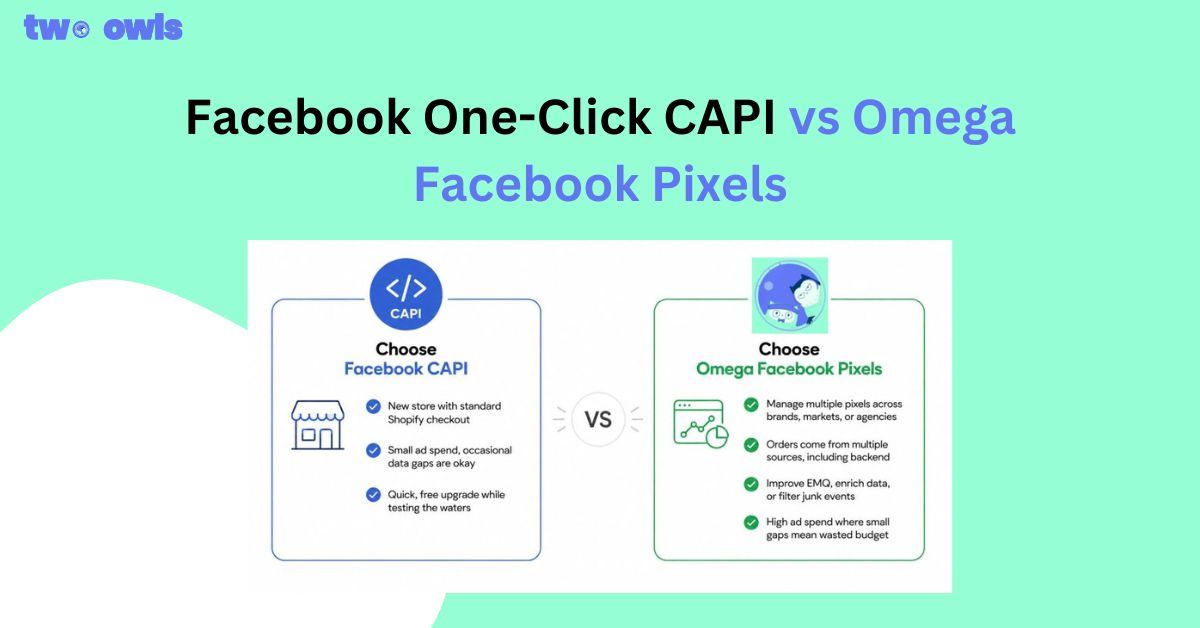
Facebook One-Click CAPI vs Omega Facebook Pixels: Which Is Better for Shopify?
Google Performance Max: A complete guide to setup, optimization, and reporting
Google Ads ROAS 2026: How to calculate, break even, and improve it
Meta Ads Click Fraud: How Bots Drain Your Budget and Poison Your Pixel (2026 Guide)
Google Ads ROI: 7 Ways to Get More Value From Every Ad Dollar