Google Ads Shopify Orders: How Many Are Tracked?


Across hundreds of Shopify stores running Google Ads, about 1 in 6 orders could be linked to Google, either through a UTM tag or a Google click ID. About half of all orders carried neither, so no report could say where they came from. If you run Google Ads on a Shopify store, that is why your ad account and your order report rarely show the same number. This article explains where the gap comes from, what the numbers look like across stores, and how to read your own data without drawing the wrong conclusion.
How Google Ads Shopify orders are counted
The shares below come from aggregated, anonymized order data across hundreds of Shopify stores running Google Ads in September 2026. They are weighted by order count, so a store with a thousand orders counts for more than a store with ten. That means the figures lean toward larger stores, and your own store may look different.
Each order is assigned to a platform in two steps. If it has a UTM tag, the platform named in utm_source gets the credit. If it has no UTM tag but still carries a Google click ID (gclid, gbraid, or wbraid), it is credited to Google. Orders with neither are grouped as Direct (no UTM). That grouping affects every number in this article, so keep it in mind as you read.
Three findings on Google Ads Shopify orders versus Facebook and Direct
Facebook is ahead of Google in tagged orders. Facebook accounts for about 22.3% of orders and Google for about 16.8%.
Google shows up in about 2 in 5 stores. Some 43% of stores recorded at least one order credited to Google through UTM tags.
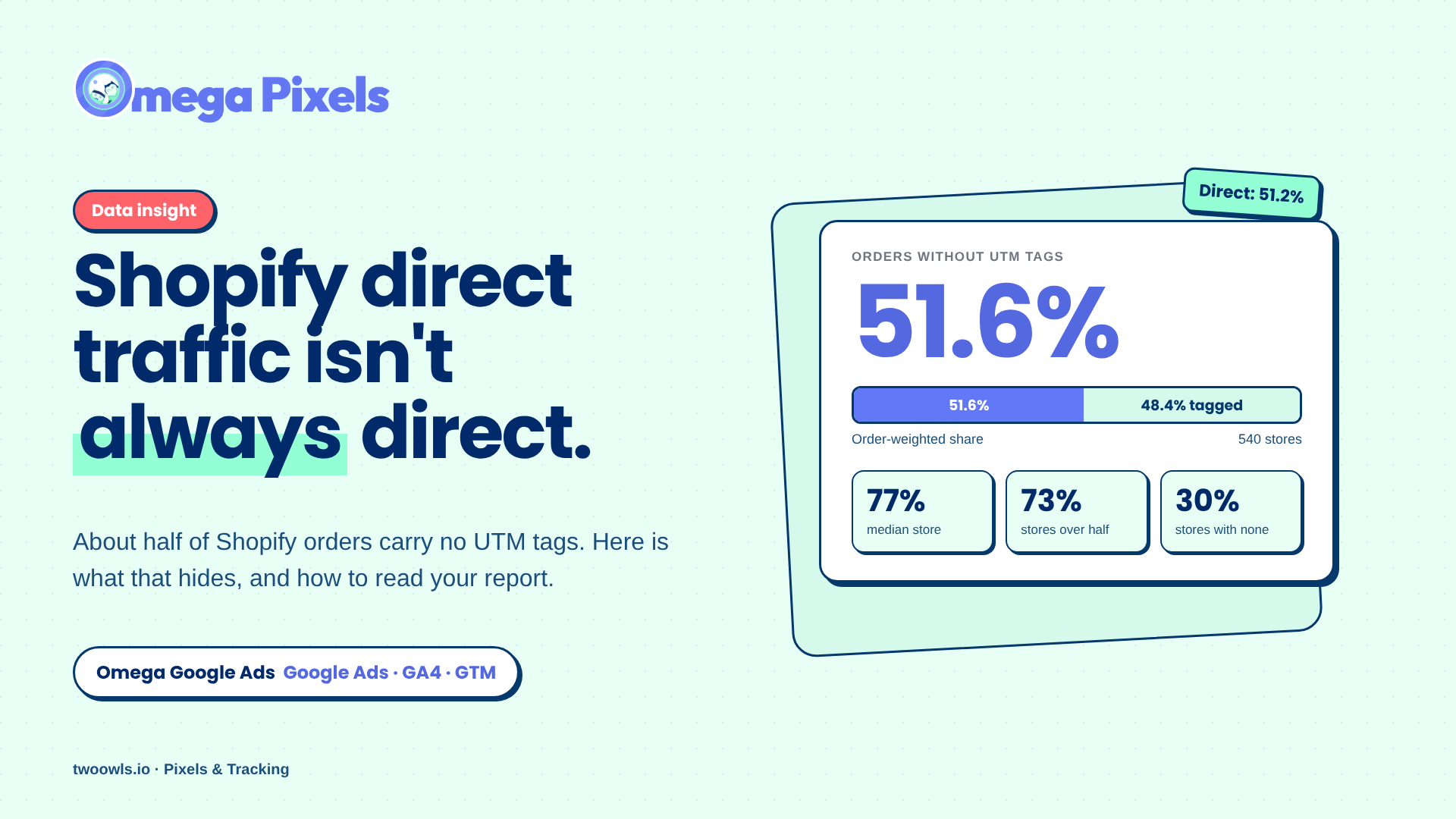
About half of all orders have no UTM tags. That is about 51.6% of orders, and the platform view groups them as Direct (no UTM).
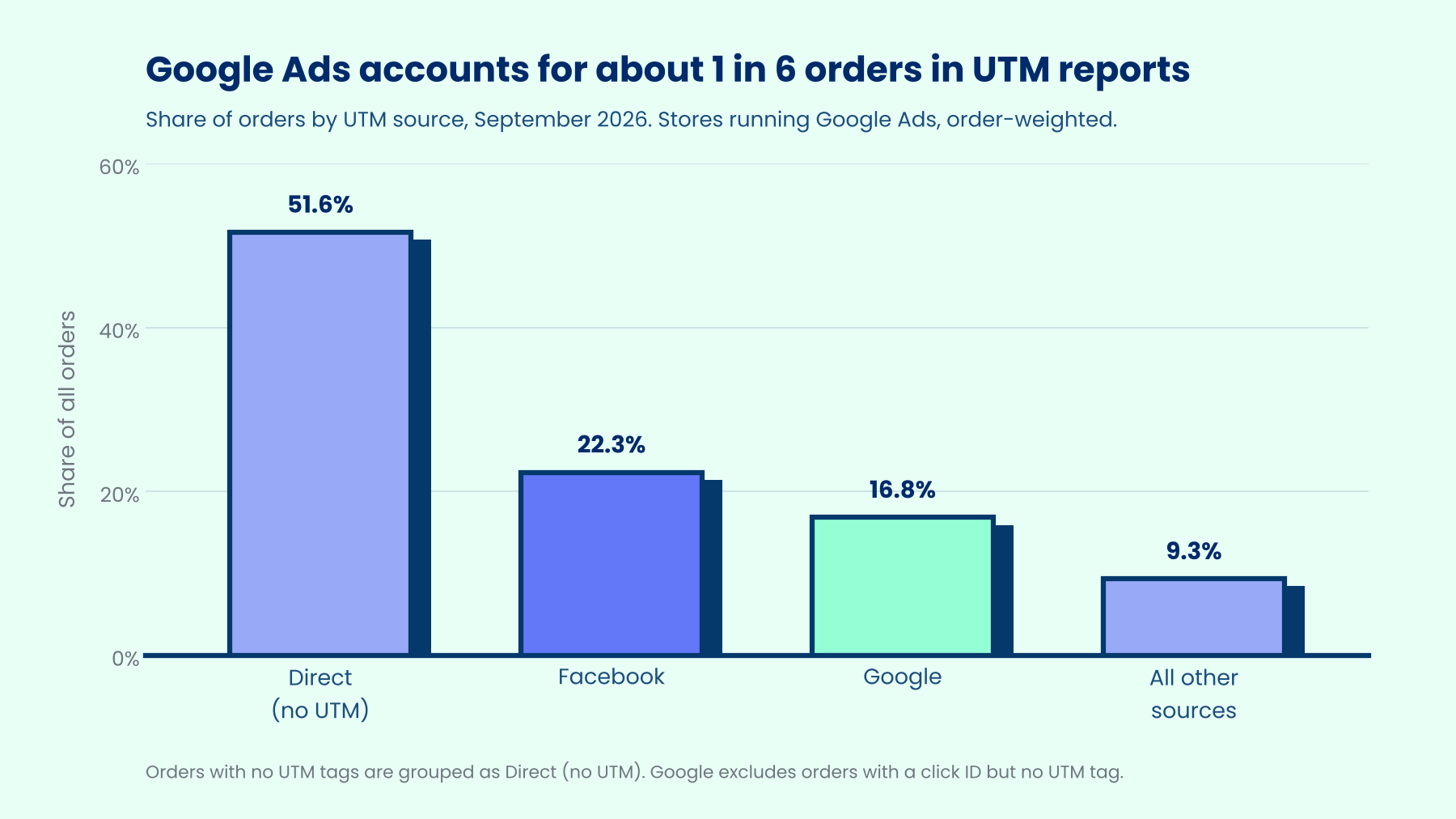
Facebook vs Google Ads Shopify orders in UTM reports
In this group, Facebook accounts for about 22% of orders and Google for about 17%. Read that gap carefully. Both shares depend on tagging. A channel whose links carry UTM tags more consistently will look bigger in the report, even when its real contribution is closer to the other channel than the numbers suggest. It is a weaker basis for judging which platform works better.
Google Ads Shopify orders appear in about 2 in 5 stores
About 43% of stores recorded at least one order credited to Google through UTM tags. The rest either had no Google-tagged order in the month, or had Google traffic that arrived without UTM tags. That second group is where the gap grows, and it is the main reason the Google figure should be read as a minimum. A store can run active Google Ads and still show very few Google orders in a UTM report if its orders carry click IDs but no UTM tags.
Why orders without UTM tags show as Direct (no UTM)
About 52% of orders carry no UTM tags. In the platform view, that bucket is larger than Facebook and Google combined, so it dominates the report. Some of these orders are genuine direct visits, such as a shopper typing the store address into the browser. Others are ad clicks whose UTM tags were never added, or lost on the way to checkout. Shopify's Help Center defines Direct as a customer entering the store URL into their browser, and Google Analytics 4 uses a similar Direct channel for visits with no source. The same label can therefore mean different things in different tools.
Why Google Ads orders are undercounted without click IDs
A Google Ads click can be tracked without any UTM tag, through a click ID such as gclid. When auto-tagging is on, Google adds a click identifier to the landing page URL of each ad click. For standard web clicks, that parameter is gclid. Google's guidance also notes that auto-tagging takes priority over manual tagging in Google Analytics 4, because there is no override option.
Google documents two related identifiers for iOS. The gbraid parameter helps measure app conversions driven by ad campaigns on iOS, and the wbraid parameter helps attribute website conversions from iOS ad clicks back to the campaign, as described in Google's iOS 14 campaign measurement guidance. These identifiers matter when a shopper moves between an ad, an app and the website.
The consequence is simple. An order can arrive with a Google click ID and no UTM tag at all, and it can still be traced back to Google Ads. That is why the 17% above includes those orders. The real risk is losing the click ID itself. If it drops off between the landing page and checkout, the order falls into Direct (no UTM), and Google Ads may never record the conversion. Smart Bidding works from conversion data, as Google’s Smart Bidding guidance explains, so those missing conversions affect bidding as well as reporting.
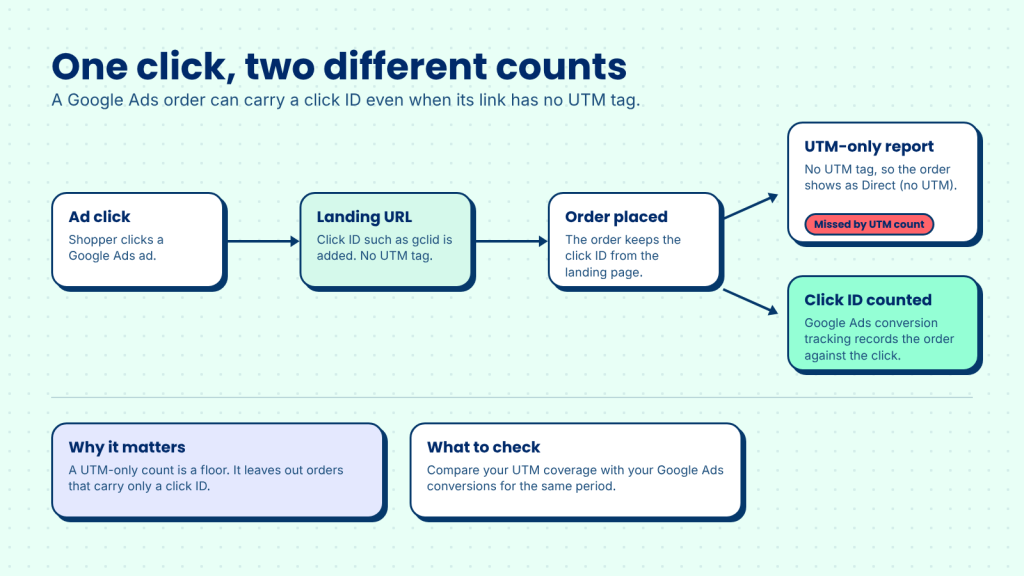
UTM tracking for Shopify: what tags can and cannot capture
A UTM tag is a set of parameters added to a link, such as utm_source, utm_medium and utm_campaign. Google's URL builder guidance defines each one. UTM tags tell the report where a click came from, but they only work when someone adds them. Email, SMS and partner links are not tagged automatically, so they are the first place to check when a channel looks smaller than expected.
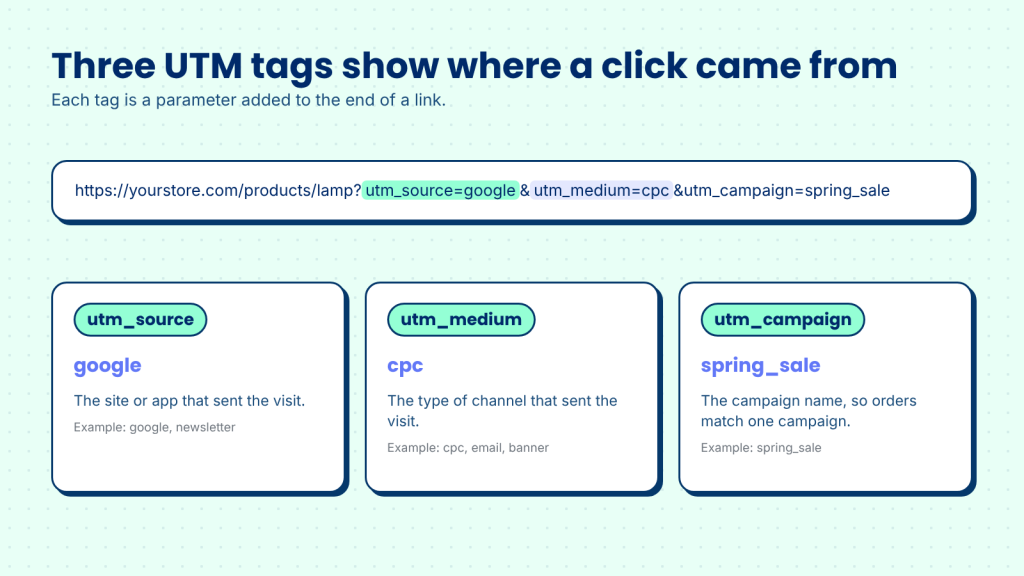
Last non-direct click: how Shopify credits Google Ads orders
Shopify's default attribution uses the last non-direct click model. Under that model, an order is credited to the last channel a customer used before buying, and direct visits are left out of the credit. If every visit in a customer's path is direct traffic, the order is attributed as direct, as Shopify's marketing performance guidance explains. A shopper who clicked a Google ad last week and typed the store address today may therefore still appear as Direct. An attribution model is a rule for crediting a sale, not a fact about the shopper, so compare reports that use the same model before you draw conclusions.
What to check in your Shopify order report before you judge Google Ads
Start with your own UTM coverage, not with the Google number. If most of your orders carry no UTM tags, a low Google share tells you more about your tagging than about your campaigns. Once you know your coverage, you can read the channel shares with the right amount of caution.
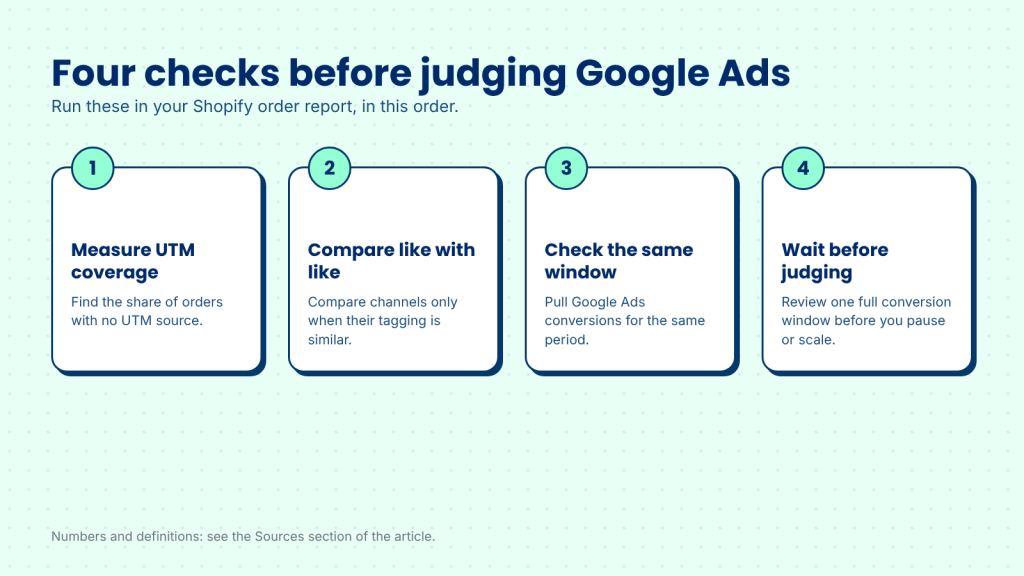
- Measure UTM coverage. Find the share of orders with no UTM source in your order report for the month you are reviewing, and record it next to the channel shares.
- Compare like with like. Compare Google and Facebook only when their UTM coverage looks similar. A channel with weak tagging will look smaller even when it sells well.
- Check Google Ads conversion tracking for the same window. Pull Google Ads conversions for the same period and attribution window. Some difference is expected. The goal is to understand the difference, not to force the two numbers to match.
- Wait before you judge a campaign. A single week of Direct-heavy data can make a working campaign look weak. Review at least one full conversion window before you pause or scale.
With Omega Google Ads, every order that still carries a Google click ID is credited to Google Ads, even when the ad link has no UTM tags.
A question to ask your Google Ads order report
How much of your order volume does your report credit to Google Ads today, and how much of it sits under Direct (no UTM)? If the second number is larger than the first, your next step is tagging, not budget.
Limits of these Google Ads Shopify order figures
- One month: the figures cover September 2026 only, so they show a snapshot rather than a trend.
- UTM-based shares: each channel share counts only orders with UTM tags, so each one is a minimum, not a complete total.
- Your store may differ: a single store can look very different from the group average, depending on its traffic mix, its campaign setup and its checkout flow.
Conclusion
Google Ads Shopify orders are easy to undercount, because a UTM report only sees orders that carry UTM tags. In September 2026, that view credits about 17% of orders to Google Ads, and the figure should be read as a floor. Before you change budget, check how many of your orders have no UTM tags, compare Google with Facebook only where their tagging looks similar, and review Google Ads conversions for the same window. If most of the gap sits under Direct (no UTM), the first fix is tagging your links, and the second is a fair read of the results.
- 1 How Google Ads Shopify orders are counted
- 2 Three findings on Google Ads Shopify orders versus Facebook and Direct
- 3 Why Google Ads orders are undercounted without click IDs
- 4 What to check in your Shopify order report before you judge Google Ads
- 5 A question to ask your Google Ads order report
- 6 Limits of these Google Ads Shopify order figures
- 7 Conclusion
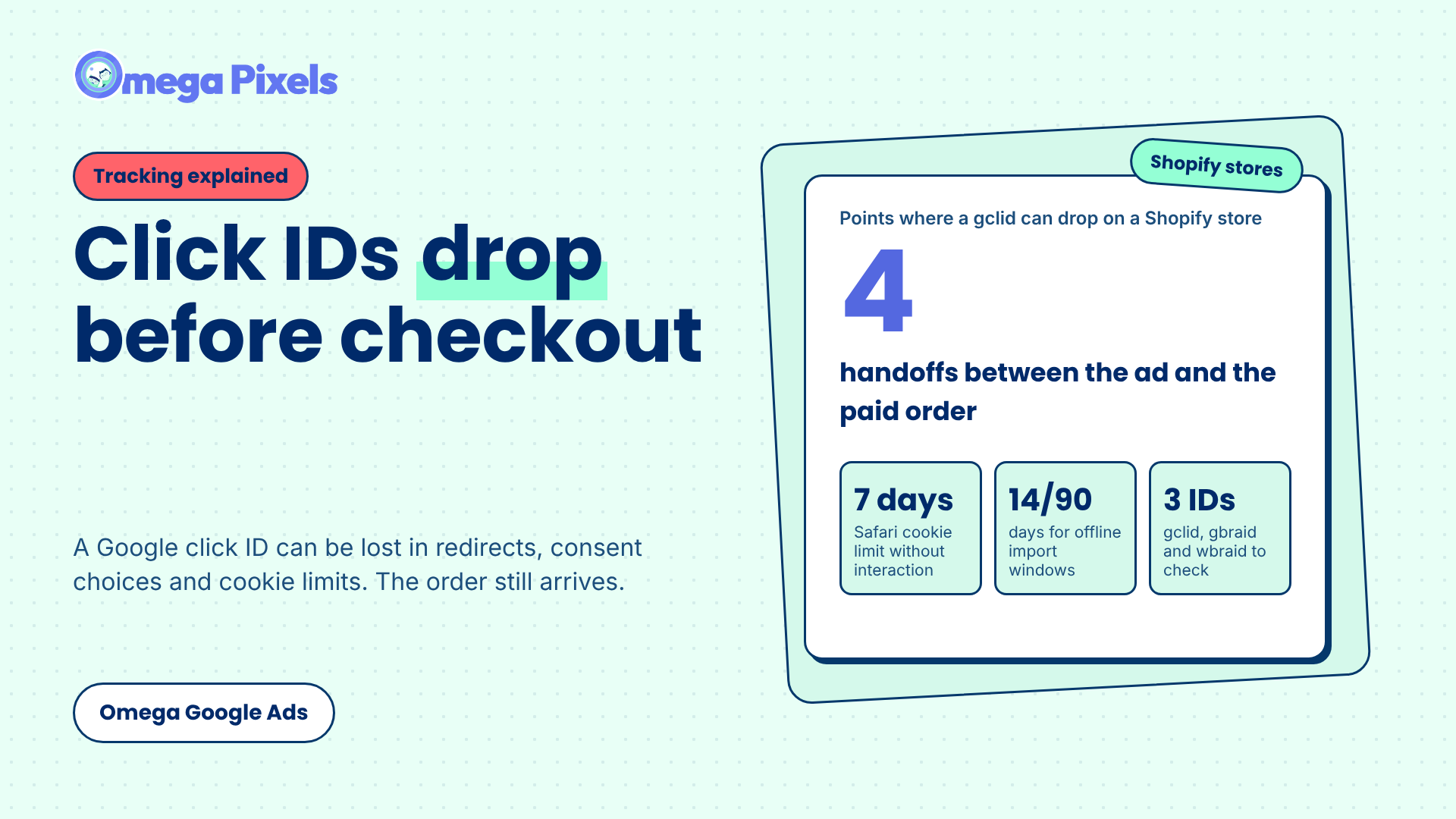
Where Google Click IDs Get Lost Between the Ad and Checkout
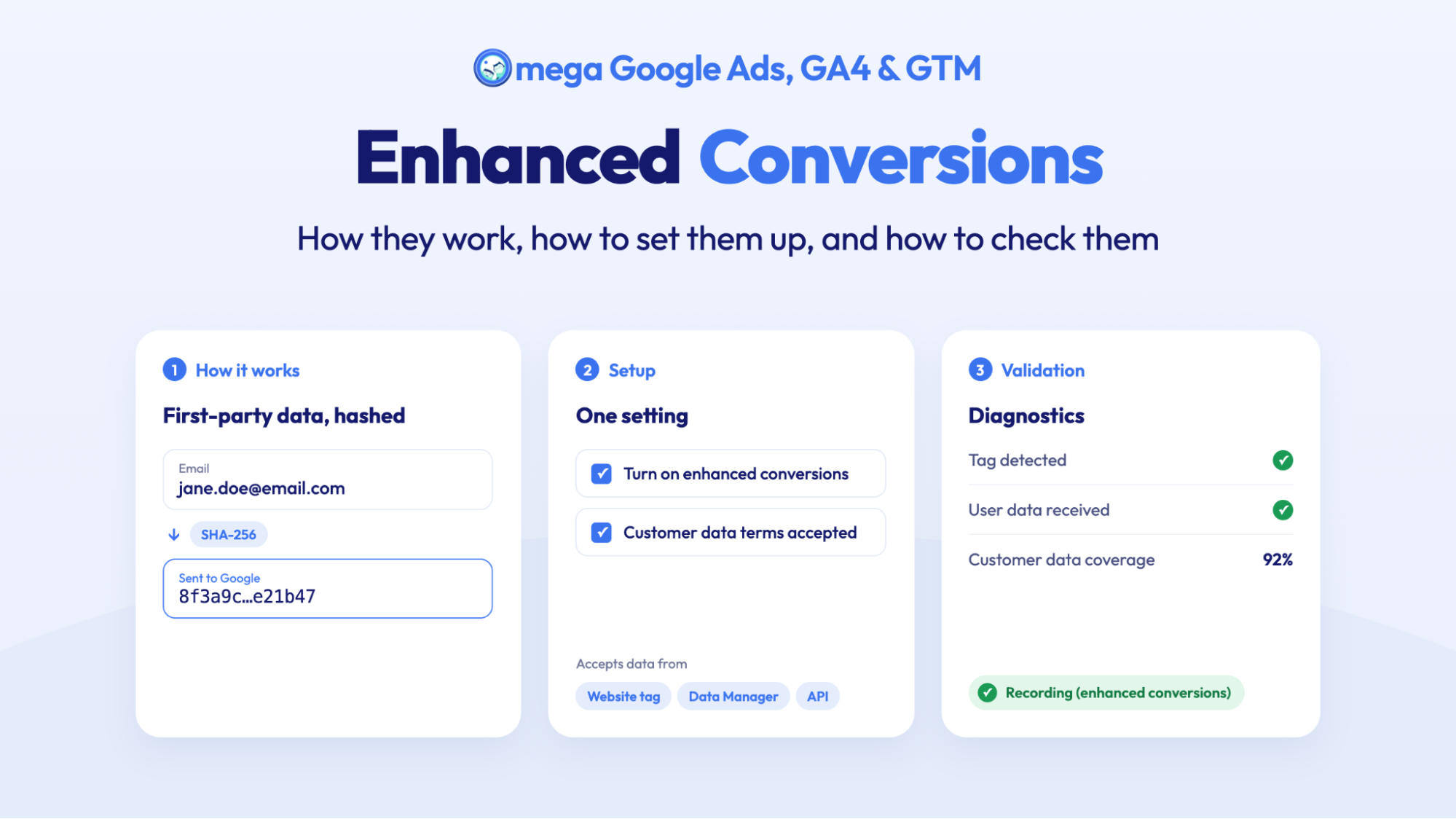
Enhanced Conversions in Google Ads: Turned On Isn’t the Same as Working
Shopify Direct Traffic Isn't Always Direct
Why Pay for Omega Facebook Pixel When Meta’s Facebook & Instagram App Is Free?
11+ ChatGPT ads examples for online stores (with copy templates)
Where Google Click IDs Get Lost Between the Ad and Checkout
Enhanced Conversions in Google Ads: Turned On Isn’t the Same as Working
Shopify Direct Traffic Isn't Always Direct
Why Pay for Omega Facebook Pixel When Meta’s Facebook & Instagram App Is Free?